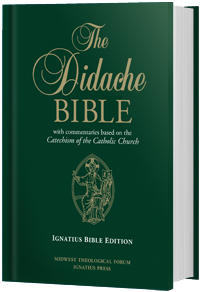
The Didache Series
| Publisher: Midwest Theological Forum Author: Scott Hahn and others Review last updated: September 2011 |
Instant KeyPublishers InfoPricing |

The Didache Series
The Didache Series, only recently published in 2003, immediately raised the bar for Catholic religion texts for high schools and colleges. The series began with four rather large textbooks, ranging in size from 400 to 832 pages, each a year-long course. These are gorgeous books, heavily illustrated in full color with religious art, maps, and photos.
Titles of the four original texts are Introduction to Catholicism, Understanding the Scriptures, The History of the Church, and Our Moral Life in Christ. Even though the content is challenging, Catholic homeschoolers have found these to be well-written, magisterium-faithful courses that work well for home education. Many Catholic high schools as well as colleges and universities have also adopted them, and adults have purchased them for personal use. However, in 2007, the USCCB approved a new curriculum framework for high school level that all Catholic schools are to follow. In this new framework, six semesters have designated topics while elective options are given for the other two semesters. The framework requires coverage of these topics:
I.The Revelation of Jesus Christ in Scripture
II. Who Is Jesus Christ?
III. The Mission of Jesus Christ (The Paschal Mystery)
IV. Jesus Christ’s Mission Continues in the Church
V. Sacraments as Privileged Encounters with Jesus Christ
VI. Life in Jesus Christ
Optional electives are:
Option A. Sacred Scripture
Option B. History of the Catholic Church
Option C. Living as a Disciple of Jesus Christ in Society
Option D. Responding to the Call of Jesus Christ
Option E. Ecumenical and Interreligious Issues
Since the original Didache courses covered most or both the required and optional topics, the publisher decided to begin by first rearranging the content of the original books. Then they added what was required to fill in the gaps. The result is a new eight-book series of semester-long courses that align with the Bishops’ framework. Titles of the semester textbooks are:
Faith and Revelation: Knowing God through Sacred Scripture
The Blessed Trinity and Our Christian Vocation
The Mystery of Redemption and Christian Discipleship
The Church: The Sacrament of Salvation
The Sacraments: Source of Our Life in Christ
Our Moral Life in Christ (Semester Edition)
Understanding the Scriptures (Semester edition)
The History of the church (Semester edition)
The first six of these titles cover the required topics while the last two reflect two of the approved options. Note that while titles of three books in each series are the same or similar, there is a drastic difference in the size of the books. Semester-course texts are about 250-330 pages each. The original books are called “Complete Courses” while the new ones are “Semester Courses.” The semester courses should be manageable for the average student although they still have more content than most other religion courses. Students should be covering two texts per school year. Keep in mind that these are very heavily illustrated texts, so the amount of reading is not overwhelming.
Student workbooks and teacher’s manuals are available (or will soon be available) for all textbooks from both series. Workbooks require students to answer questions in many different formats. Answers to workbook questions are in the teacher’s manuals.
All texts draw on Scripture, the Catechism, Church Fathers, and Church documents, frequently quoting from these sources. The semester-course books have discussion questions at the beginning of each chapter and “study” questions and “practical” questions at the end of chapters. Study questions might be done independently but other questions are really meant for discussion. Vocabulary and catechism paragraphs referenced in each chapter are also handy at the end of each chapter.
In both semester- and year-long courses, a few pages of “Supplementary Reading” at the end of each chapter bring in primary source material related to the topic which enhances the chapter content and helps familiarize students with resources such as encyclicals, writings of the Church Fathers and saints, documents from church councils, and other historical documents.
Teacher’s manuals feature reduced reproductions of student text pages, lesson plans, additional instructional material, tests, quizzes, vocabulary reviews, answers to study, responses for practical exercises, suggestions for long-term assignments, teaching tips, and a collection of prayers and devotions. Teacher’s manuals also include a CD with printable tests, quizzes, and vocabulary review. Note that previous teacher’s manuals for the complete courses separated the teacher manual and workbook answer guide into two separate resources. Also, there was no CD. The new TMs are a great improvement, but they are expensive!
I’ll add a few notes on particular textbooks.
Understanding the Scriptures (Complete Course) was written by well-known author Dr. Scott Hahn. This text reflects a love and respect for the Bible missing in so many Catholic texts. Many other texts give lip service to Church teaching on the inspiration and inerrancy of Scripture then discuss the Bible as if it is no different than other historical books. They seem to have bought into the idea that Scripture is little more than culturally-limited material shaped by human whim. On the other hand, Dr. Hahn sees the Divine mind in Scripture and reads the whole as a story of God’s relationship with man through a series of covenants. He addresses the Documentary Hypothesis (J,E, D, and P sources for the Old Testament), pointing out that attempts to identify sources such as these are no more than “scholarly conjecture and speculation.” (Those who want to explore this topic more deeply can use resources in the teacher manual.) This book also has an excellent (but brief) treatment on the question of Creation and Evolution in relation to Church teaching. Dr. Hahn points out key truths from the book of Genesis that Catholics are required to believe relating to Adam and Eve and original sin. Then he points out the potential conflict with evolutionary teaching that includes the concept of polygenism which denies that all people are descended from Adam and Eve. Treatment of important points such as these makes this a text that is faithful to Church teaching while also satisfying those seeking rational understanding. It doesn’t answer all the difficult questions, but it points out key points to consider.
The History the Church (complete course), at 816 pages, can actually be used for credits in both religion and history. Since it begins with study of the origins of the Roman world and continues up through the twentieth century, this might also be considered a world history text focused on western civilization. This is a “heavy-duty” text that would almost be more suitable for college than high school. The content is not difficult, but there is just a lot of information to absorb. For example, an entire chapter is dedicated to “The Crusades, Military Orders, and the Inquisition,” providing a far more nuanced understanding of all three topics than we find in most other texts. For the dedicated student, this is a fabulous study of the development of Christianity grounded in history.
The semester course, The Blessed Trinity: and our Christian Vocation, begins with a discussion of faith and revelation, although “faith and reason” might be an apt description of this first chapter since it is an excellent presentation of the big questions young people have to address regarding their beliefs. The second chapter is an overview of the Trinity, then the next four chapters are dedicated to the persons of the Trinity with two chapters on Jesus, one on His nature and the other on His life and teachings. The last chapter is on the Blessed Virgin Mary.
The Sacraments: Source of Our Life in Christ covers material originally in the complete course, Introduction to Catholicism. This book culminates with a final chapter on liturgy that covers the liturgical year, sacramental, prayers, statues, icons, pilgrimages, and other topics related to Catholic worship.
Pricing
Understanding The Scriptures: A Complete Course On Bible Study (The Didache Series)

Scott Hahn
- $30.00 List Price
- $50.00 New at Amazon.com Marketplace
- at ECampus.com
The History of the Church (The Didache Series)

Peter Fr. Armenio
- $40.00 List Price
- $50.00 New at Amazon.com Marketplace
- at ECampus.com
Introduction To Catholicism: A Complete Course

James Socias
- $42.95 List Price
- $24.97 New at Amazon.com Marketplace
- at ECampus.com
Our Moral Life In Christ: A Complete Course, Third Edition

- $42.95 List Price
- $38.95 New at Amazon.com Marketplace
- at ECampus.com
Sacraments: Source of Our Life in Christ Student Textbook

James Socias
Faith and Revelation: Knowing God Through Sacred Scripture

Scott Hahn
The History of the Church: Semester Edition (The Didache Series)

Peter V. Armenio
Our Moral Life in Christ Student Textbook Semester Edition

Peter V. Armenio
The History of the Church (Semester Edition) Student Workbook (The Didache Series)

Understanding the Scriptures: Semester Edition (The Didache Series)

Scott Hahn
Understanding the Scriptures Student Workbook (Complete Course Series) (The Didache Series)

Instant Key
- Suitable for: class or one-on-one situations with much independent work
Audience: high school
Need for parent/teacher instruction: moderate
Prep time needed: minimal
Teacher's manual: N/A
Religious perspective: Catholic
Publisher's Info
-
Midwest Theological Forum
1420 Davey Rd.
Woodridge, IL 60517
630-739-9750
Ordering | Submit Products for Review
All reviews and articles on this site belong to Cathy Duffy unless otherwise identified. No review or article may be copied or reprinted without permission except for a single copy of a review made for temporary use AND not shared with others.
© Copyright 2011 - Cathy Duffy Web Design by Servator Design


.jpg)