

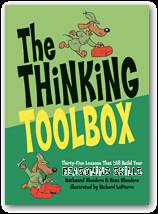
The Bluedorn brothers authored The Fallacy Detective, and The Thinking Toolbox is the next step up from that book. Suggested for ages thirteen and up, it still focuses on informal logic, just presenting more complex examples, applications, and questions.
The book is divided into three main sections plus a smaller section of suggested activities and logic games to play. The three main sections are Tools for Thinking, Tools for Opposing Viewpoints, and Tools for Science.
The first section, Tools for Thinking, follows the same vein as The Fallacy Detective focusing primarily on arguments. It addresses topics such as differences between discussions, disagreements, arguments, and fights; facts, inferences, and opinions; identifying the premises and conclusion of an argument; and when it is wise not to use logic. I was really glad to see that lesson 7, considering opponents' arguments, uses some of the hard questions about Genesis as the first example. They don't supply you with the counterarguments here, but they will make you think about what you need to know to enter into a challenging discussion of the topic.
The next section, Tools for Opposing Viewpoints, addresses evidence: primary versus secondary sources, corroborating evidence, circumstantial evidence, ulterior motives that affect reliability, possibilities versus probabilities, and more.
The third section, Tools for Science, shows how good science and good thinking go hand in hand. Lessons focus on observation, brainstorming, forming hypotheses, testing hypotheses, analyzing data, and pseudoscience.
Like The Fallacy Detective, examples are often humorous. Ideas are almost always presented in some sort of story or situational context. This makes it much easier to think about the concepts than when it is presented primarily in a theoretical fashion.
Suggested solutions are at the back of the book so there is no separate answer key.
While this book is written by Christians and seems to presume a Christian audience, it has few references to Christian ideas.
While a high school student can work through this book on his or her own, it really will be a lot more fun to read and discuss the questions with at least one other person. And I suspect that parents will enjoy going through the book even more than will their teens.