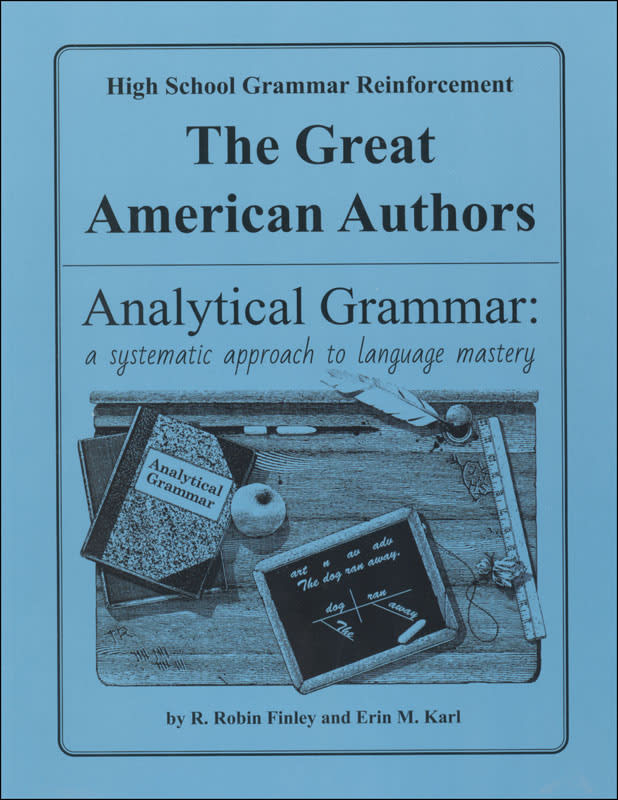




Robin Finley drew upon her years of teaching experience to develop Analytical Grammar, and Demme Learning has significantly revamped and improved this excellent program to make it even easier to use. The program has five levels that do not correspond to grade levels. They concentrate on grammar and usage but are not comprehensive language arts courses. You should use them alongside other resources that cover reading, composition, spelling, and handwriting each year. The five courses are:
- Grammar Basics
- Mechanics
- Parts of Speech
- Phrases and Clauses
- Punctuation and Usage
You could begin the first book with an advanced third grader, but fourth grade is probably ideal. Students in junior or senior high who have already studied grammar might begin with the third course, since the last three courses review and expand upon the first two. Placement activities on the Demme Learning website will help you determine the best starting place. One of the important features of this program is that it teaches thoroughly and doesn't require reteaching topics like parts of speech and punctuation every year. Instead, students practice what they have learned through continual application. Other key features are that students learn parts of speech and syntax at the same time, with sentence diagramming introduced early and taught along with parts of speech. Also, a sentence parsing process is used that is similar to a flow chart approach with questions and answers.
Each level has a student worktext and an instructor handbook, both of which are softcover books printed in black and white. The student worktexts have space for answering most questions. Still, some courses require students to occasionally write a paragraph or more, and the first and third courses require extensive sentence diagramming. In those cases, students will generally need to write or create diagrams outside of their worktexts.
The instructor handbooks have most of the content of the student books but with additional information for the teacher and overprinted answers. Notable exceptions are the reinforcement activities and answer keys in the third and fourth courses, which are both found only in the student worktexts.
Complete grading information is provided for the teacher. Finley has carefully thought through the difficulties in grading both sentence diagrams and writing assignments, and she presents complete answer keys with point systems for parents to use for scoring complex answers such as sentence diagrams.
Most lessons in all five courses follow a similar pattern. Each lesson should take five days to complete. On Mondays, correct or review the lesson assessment from the previous Friday, go over lesson notes (instruction) with the student, and then have the student complete exercise A. On Tuesdays, review exercise A together and have the student do exercise B. On Wednesdays, review exercise B and have the student complete exercise C. On Thursdays, review exercise C and have the student complete "Playing with words" in the first level or the Application & Enrichment activity in other levels. On Fridays, review Thursday's activity and have the student complete the lesson assessment.
The student worktexts for courses 3, 4, and 5 have perforated pages and an index at the end of the book. Students can remove pages with lesson notes, the Application & Enrichment pages, and the index and then put them in a binder for use as a reference handbook. (Students will either need to three-hole-punch pages or put them into sheet protectors.)
Following are details on each course.
1. Grammar Basics
Grammar Basics has 11 lessons that can easily be completed in less than a semester. It focuses on parts of speech and syntax (word functions within a sentence), and it introduces sentence diagramming early in the process. Graphic organizers are frequently included in the student worktext to make it easier for them to answer questions. In addition, the "Playing with words" activities require students to write several sentences.
2. Mechanics
Mechanics has 16 lessons covering punctuation, capitalization, and usage. It begins with commas, assuming that students already know about the use of periods, question marks, and exclamation points. Seven lessons are devoted to comma usage, and other lessons address direct quotations, titles, possessives, capitalization, pronoun-antecedent agreement, subject-verb agreement, nominative and objective case pronouns, correct usage and forms of adjectives and adverbs, and transitive and intransitive verbs. Students also learn to use editing marks to identify errors in some exercises. There are no sentence diagrams in this course. This course might be used in the same year as the first course.
3. Parts of Speech
Parts of Speech reviews and expands on the first course, and it might be the starting place for students who have previously studied grammar. The first lesson begins by quickly reviewing nouns, adjectives, and articles and then parsing sentences to identify all three. Students learn to paraphrase material written by others in some Application & Enrichment exercises. Sentence diagramming is introduced in the third lesson, immediately teaching how to diagram sentences with prepositional phrases. The course incorporates lots of diagramming.
The main part of the course consists of 10 lessons, but there are also 18 reinforcement lessons. The reinforcement lessons use brief excerpts from well-known literary works and have students parse and diagram sentences and write paraphrases of paragraphs. Answer keys are in the student worktext for students to check their own work. Student paraphrases might be challenging for parents to evaluate, but parents are told to judge how well the student conveyed the original meaning as well as the number of substitutions for keywords.
4. Phrases and Clauses
Phrases and Clauses begins with a week-long review of Parts of Speech. After that, there are seven lessons plus 10 reinforcement lessons. Students review sentence patterns and learn about four types of phrases (participial, gerund, infinitive, and appositive) and three types of clauses (adjective, adverb, and noun). They will parse and diagram many sentences, complete graphic organizers, and answer questions with short answers.
The reinforcement lessons use brief excerpts from well-known literary works and have students parse and diagram sentences and write paraphrases of paragraphs. Answer keys are in the student worktext for students to check their own work.
5. Punctuation and Usage
Punctuation and Usage has a week-long review of Phrases and Clauses, then provides 19 lessons. While this course repeats much of the instruction in Mechanics, it does so at a higher level of difficulty with more-complex sentences in the exercises. It adds two lessons on semicolons and colons and on active and passive voice, as well as weekly Application & Enrichment activities that vary in format.
High School Grammar Reinforcements
Once high school students have completed Analytical Grammar or another rigorous grammar program with diagramming, they might still need some sort of review or practice to keep their skills sharp.
Robin Finley and her daughter Erin Karl created four High School Reinforcement books for this purpose. Each book has activities that reinforce sentence parsing and diagramming, grammar analysis, punctuation, and usage. With 18 lessons per book, you would use approximately one lesson every two weeks for a school year. Each book contains its own answer key.
The titles are The Great American Authors, The Great British Authors, Shakespeare’s Plays, and The Great World Authors. You might select a book to coordinate with literature studies. The sentences and passages with which students work all include information about authors and their works that is readable for its own sake––something we rarely find in grammar resources.
Summary
The Analytical Grammar courses do a thorough job of teaching grammar and usage. Some students might find the courses challenging, especially the sentence diagrams, but the efficiency of the program means you can move at a slower pace through a course if needed. I think most parents and students will appreciate the efficiency of this approach.