
Michael Clay Thompson’s classical language arts program (MCT) has seven complete levels, and each level has a set of six courses. Levels 1 through 7 can be used beginning at either third or fourth grade. There is also a Preliminary Level, the Poodle series, with briefer books that can be used before starting Level 1. The entire program was written with gifted students in mind, so the courses might be used through high school.
Preliminary Level: The Poodle Level
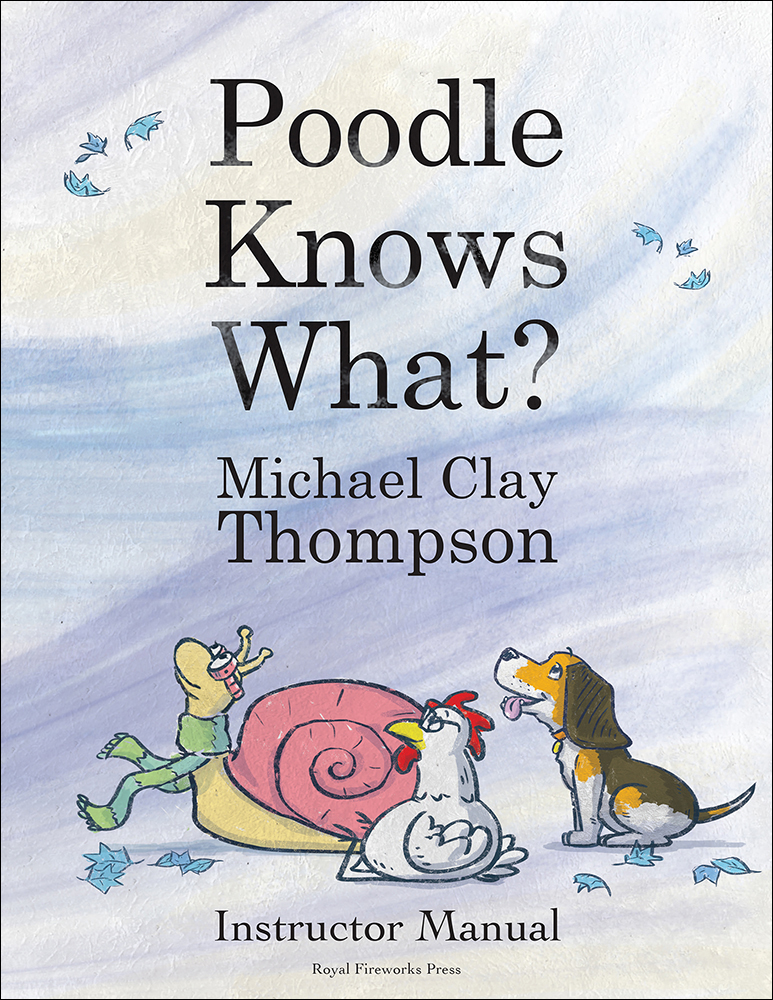 The Poodle Level provides a delightful introduction to the MCT program with a set of six books: Poodle Knows What?, Poodle and the Blue Mountain Monster, Poodle Knows Poetry, Poodle and the Blue Desert Dunes, Poodle and the Art of the Comma, and Poodle Knows Clauses. The instructor manual for each student book has the complete student text plus helpful annotations and explanations that might be shared by the teacher. It also has answers for the occasional exercises.
All six books are gorgeously illustrated in vibrant color, and the text is equally delightful. A chicken named Poodle and a beagle named What? are characters in the narrative of each book. They sometimes become aware that they are on pages or on a stage, and they often step off the edge of a page to either move to the next scene or disappear. Poodle and What? frequently look up and down from the page to check if they are being observed. They also interact with the author from time to time. The creative storytelling is a major highlight of this series. Here's one brief example from page 56 of Poodle Knows What?:
WOOOOOhoooooooooo! With a yell,
laughing all the way, down they fell,
the chicken and the beagle—a long dive,
hoping to land in Chapter Five.
Thompson's whimsical use of both language and storytelling makes these books fun to read. Most pages in the books have QR codes that link to online audio files of Thompson reading the books aloud. Hearing the author's intonation is very helpful, so I highly recommend using these for at least one reading of the books.
The delightful narratives also have solid educational content that take students through the MCT's four-level analysis. The first book teaches the eight parts of speech. The second teaches five parts of the sentence: subjects, action verbs, direct objects, linking verbs, and subject complements. The third book teaches poetry. The fourth teaches about prepositional phrases. The fifth teaches punctuation, and the sixth teaches about clauses.
The Poodle books are written, as Thompson says, "in poetic playfulness." (Poodle Knows Poetry: Instructor Manual, p. 132). They all employ poetic elements—sometimes with perfect rhymes or near rhymes that we expect in poetry, but also with alliteration, assonance, internal rhymes (in the middle of a line), and other poetic elements. The text in all three books is center justified which gives it a poetic appearance. While Poodle Knows Poetry teaches about specific poetic elements, it also integrates a review of sentence elements as in this excerpt from page 15:
There are forest verbs such as
hide, peek, crouch, and sneak
and sudden midnight shriek. That's bleak.
The Poodle Level is not required before starting Level 1, but I wouldn't miss this series.
Levels 1 through 7
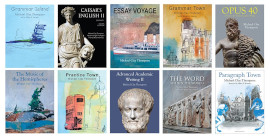 The publisher's website shows the seven levels divided into two sets with the first three levels designated "Elementary" and the last four levels designated "Middle and Secondary." Despite the grade level recommendations, I would generally suggest starting at the beginning of the series in most situations since there is a cumulative building process that occurs with these books that might be difficult to plug into midstream.
Following is a list of the six courses for each level with suggested grade levels.
Level 1 - for 3rd grade and up:
Grammar Island, Practice Island, Building Language, The Music of the Hemispheres, Sentence Island, The Mud Trilogy
Level 2 - for 4th grade and up:
Grammar Town; Practice Town; Caesar’s English I; Building Poems; Paragraph Town; Alice, Peter, and Mole (literature)
Level 3 - for 5th grade and up:
Grammar Voyage, Practice Voyage, Caesar’s English II (or CEE 2), A World of Poetry, Essay Voyage, The Search Trilogy
Level 4 - for sixth grade and up:
Grammar of Literature, 4Practice for Literature, Vocabulary of Literature, Poetry of Literature, Writing of Literature, The Shadow Trilogy
Level 5 - for 7th grade and up:
Magic Lens 1, 4 Practice 1, The Word Within the Word 1, Poetry and Humanity, Advanced Academic Writing 1, The Time Trilogy
Level 6 - for 8th grade and up:
Magic Lens 2; 4 Practice 2; The Word Within the Word 2; Poetry, Plato and the Problem of Beauty; Advanced Academic Writing 2, The Fog Trilogy
Level 7 - for 9th grade and up:
Magic Lens 3; 4 Practice 3; The Word Within the Word 3; Poetry, Plato and the Problem of Truth; Advanced Academic Writing 3, American Autobiography
Although the six courses for each level have different titles from year to year, they cover six strands: grammar, grammar practice, writing (composition), vocabulary, poetry, and literature—all at more challenging levels than are typically found in other texts for comparable grade levels. The inclusion of poetry at every level is unusual, but it is a critical element in the program. The integration of the six courses for each level creates a synergistic effect: the whole is greater than the sum of the individual parts. Nevertheless, you can use the courses individually.
Each course has both a student text and a teacher manual. Students always need to see the pages since artwork and layout are often as much a part of a lesson as the text. A student and teacher may work together in the same book if need be, but the student does need access to each book. Most student books are not consumable, but students definitely need to write in the Practice books—Practice Island, Practice Town, etc., but these are the only ones that function like workbooks. To make learning easier for children for neurodivergent learners, Royal Fireworks Press is starting to produce video books—complete student books on videos that include audio for students to hear as they read the content on the screen. As of March 2025, video books are available for The Word Within the Word series and The Grammar of Literature. These interactive video books are accessed online and include questions that are evaluated immediately by the program.
Some of the teacher manuals have small boxes and circles with teaching suggestions overprinted on student pages, but teaching information is often separated into a section at the back of the teacher manual after a copy of the student text. (Homeschool packages include the less-expensive Parent Manual for some courses rather than a teacher manual. Parent Manuals do not include the complete student textbook.)
Thompson’s approach especially appeals to classical educators for a number of reasons. Probably foremost among them are the introduction of Latin and Greek roots, the use of classical literature, and the development of thinking skills. Most obvious is the vocabulary study based upon Latin and Greek stems. A brilliant addition is Thompson’s occasional references to Spanish vocabulary and grammar since Spanish, too, draws on Latin roots and is a living language with which students can easily connect. The courses use excerpts from classical literature and have composition assignments based upon the literature—just a few examples of how the literature plays an important role. Thompson frequently uses a Socratic approach for teaching—using questions to help students discover answers or concepts for themselves. Socratic questions are just one part of a comprehensive teaching methodology that both expects and demands students to be mentally engaged with the learning process at a high level. It is very respectful of the student, but it will not work well for an unmotivated student.
MCT Grammar
The grammar courses (in sequential order) are titled Grammar Island, Grammar Town, Grammar Voyage, Grammar of Literature, Magic Lens 1, Magic Lens 2, and Magic Lens 3. In all seven grammar books, Thompson strives to simplify the presentation of grammar by using four “lenses” through which a sentence might be studied: parts of speech, parts of the sentence, phrases, and clauses.
While grammar instruction is thorough, the core instruction is given at the beginning of each year, with practice and application during the rest of the year. Thompson calls it “front-loading.”
All eight parts of speech are covered each year, with the level of complexity gradually increasing from year to year. Similarly, parts of the sentence are studied, with even the first level (Grammar Island) including subject complements, prepositional phrases, and the identification of clauses.
Thompson teaches a variation on traditional diagramming. He begins by teaching a strong vertical break between complete subject and complete predicate. But after that, diagramming plays a minor role in comparison to “four-level analysis,” a technique used at all levels as students analyze sentences for parts of speech, parts of the sentence, phrases, and clauses. The four-level analysis is introduced in both Sentence Island and Practice Island at the first level and then is used in all the grammar books for the rest of the levels. The Practice books for subsequent levels provide pages with sentences for students to analyze at the four levels.
MCT Writing
Writing is taught with a strong grammatical approach. The titles of the first three courses—Sentence Island, Paragraph Town, and Essay Voyage—reflect the sequential development of composition skills. The Writing of Literature has students work with excerpts from fiction and non-fiction to learn writing techniques. Advanced Academic Writing 1, 2, and 3 (for the last three levels) teach students to write formal academic papers. All three Advanced Academic Writing books and The Writing of Literature teach students the MLA (Modern Language Association) guidelines for writing. Advanced Academic Writing teacher manuals each include access to an online library of Thompson’s comments on student papers that he has accumulated over the years. These are comments that he has used repeatedly enough that he “recorded” them rather than rewrite them each time. A parent or teacher can use these comments to save the time it would take to figure out how to create his or her own comments.
MCT Vocabulary
Vocabulary study eschews the idea of grade-level vocabulary. Instead, from the very beginning, students are introduced to interesting and challenging words such as aqueduct, suburbs, spectacular, spectrum, introduction, and reduction. The first course textbook, Building Language, offers a gentle, artistic introduction to vocabulary by creating an analogy between architectural arches and word stems. This heavily illustrated book is a fun exploration of language that includes reading, discussion, creative writing, oral review, and quizzes that might be done orally or in writing.
Caesar’s English (CE) books I and II ratchet up the academic challenge significantly with a number of interactive activities that challenge students to analyze and apply stems and words. Analogies play a prominent role. Vocabulary continues to transcend typical grade-level lists with words such as vulgar, undulate, countenance, and prodigious in CE I and derision, sanguine, inexorable, alacrity, and obsequious in CE II. Spanish gets special attention in both CE books. The CE student texts include many photographs of Greek and Roman art and architecture, maps, word searches, a biography of Julius Caesar spread throughout both volumes, original poems by Michael Clay Thompson, more on English-Spanish language relationships, and fifteen essays by Dr. Thomas Milton Kemnitz on topics such as Roman architecture and methods of construction. I particularly like the way the CE courses reinforce and build vocabulary through poetry and essays. Both of these courses have so much content that the student book for each course is in two volumes. (The standard student textbooks are printed in black and white, but there are full-color versions available.) A single Implementation Manual for the teacher for each CE course includes reproduced student pages with answers and comments overprinted or inserted where appropriate.
The Vocabulary of Literature has ten lessons, each of which teaches ten of the most frequently used words in classic literature plus ten words from Caesar's English I and Ceaser's English II. Lessons include information and photographs about authors and literature, definitions with examples of usage from literature, "Classic Word Challenge" games (students guess which word an author used in a sentence), grammar exercises using the vocabulary words, "Classic Word Muddles" exercises (students identify usage errors), and more.
The Word Within the Word (WWW), books 1, 2, and 3 (vocabulary textbooks for the last three levels), emphasize the Latin and Greek roots of words. Many activities can be done independently or through group discussion while some written activities must be done independently. For example, one activity directs students to “translate the following ostentatious, ponderous passage into graceful, direct English.” Lengthy passages follow that include sentences such as, “He had seen it all: mendacious miscreants, peripatetic mendicants in dishabille, philandering officials, hedonistic values, pulchritudinous youths wallowing in puerile narcissism, venial sins, dissembling sycophants, refractory recidivists, querulous neighbors—a world replete with sins and problems” (WWW:3, p. 123). You can see how this type of assignment really challenges a student to understand and apply vocabulary. These books all include content about events in the classical world.
MCT Poetry
If you want to instill in your children a love of poetry but find most teaching resources less than inspiring, you will probably love Thompson’s approach which includes poetry study at every level. Even from the youngest level, students learn to appreciate the beauty of language and the skill of an outstanding poet who has carefully selected words not just for meaning and rhyme but also for the actual sounds the words make. All seven books explore the technical and mechanical aspects of poetry as well as the aesthetic and emotional. The last three books delve further into philosophical questions such as the nature of man and whether beauty and truth are relative or absolute. Thompson presents the questions in a Socratic manner, encouraging thought without offering definitive answers. Those teaching a Christian worldview might want to expand such discussions within that context.
Literature Study Courses
The literature courses can be used apart from the rest of the curriculum, but they refer to learning strategies taught within the other courses and work best in conjunction with them. The seven literature courses and the literary works studied in each are:
Level 1, The Mud Trilogy, features three novels about Mud the fish (from Sentence Island) written by Michael Clay Thompson.
Level 2, Alice, Peter, and Mole, includes the three novels Alice’s Adventures in Wonderland, Peter Pan, and The Wind in the Willows.
Level 3, The Search Trilogy, includes Treasure Island, The Call of the Wild, and The Invisible Man.
Level 4, The Shadow Trilogy, includes The Murders in the Rue Morgue, The Strange Case of Dr. Jekyll and Mr. Hyde, and The Hound of the Baskervilles.
Level 5, The Time Trilogy, studies A Christmas Carol, The Time Machine, and A Connecticut Yankee in King Arthur’s Court.
Level 6, The Fog Trilogy uses the classic novels The War of the Worlds, The Red Badge of Courage, and Kidnapped.
Level 7, American Autobiography, includes the non-fiction works The Autobiography of Benjamin Franklin, The Narrative of Frederick Douglass, and Walden.
The books studied are special editions annotated by Thompson. Annotations include vocabulary definitions, four-level analysis of selected sentences, and comments on literary elements. Thompson places the emphasis on reading and discussion instead of worksheets and comprehension questions. He includes in the parent manual selected quotations for oral “quote quizzes” where students identify either the speaker or who or what is being described. He also provides “Creative Questions and Activities” that you will most likely use for discussion as well as “Study Questions” that may be assigned for written work. Thompson provides many suggestions as to how you might use the various learning strategies with children of different ages. The parent manuals for the literature courses are both illuminating and entertaining.
Summary
The six books for each level work together to provide a comprehensive language arts curriculum. The grammar books provide an understanding of the structure of language that is used throughout all the books. Vocabulary study prepares students to explore a wider variety of literature with understanding. Poetry books feed the imagination for writing and allow students to experience the beauty of aptly chosen words they might have just learned in their vocabulary study. The literature inspires students with the excellent usage of language while also using literature to introduce students to the world of imagination and ideas. And all of this prepares students to be able to express ideas in their own speech and writing. I suspect that most parents will be inspired by these books since they reveal aspects of language arts that offer beauty and meaning.
Royal Fireworks Press offers either complete packages with both student and teacher books or packages with just the student books at discounted prices through their website. All of these books are available as printed books, and the publisher is in the process of making many of them available as Kindle books.
The Royal Fireworks Press website has Michael Clay Thompson’s free downloads, video clips, and implementation slide shows to assist parents. The publisher also sponsors online support forums to which both the publisher and the author regularly contribute.