


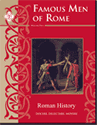
The Famous Men series was originally written by John Haaren and Addison Poland in the 1800s. The books have been revised and updated by many publishers. Memoria Press has published their versions of the following:
Famous Men of Rome
Famous Men of Greece
Famous Men of the Middle Ages
Famous Men of Modern Times
These versions and their companion study guides (created by Memoria Press authors) are better than ever.
There are three components for each book: the Famous Men book of stories that serves as your core book, a student guide, and a teacher guide. Some courses also have flashcards to help students memorize key points of information.
The core books are nicely formatted in double columns for easier reading. Plenty of detailed illustrations make the books visually interesting. The latest printing of Famous Men of Rome features full-color illustrations, a feature we'll also see in the other volumes with future printings. A helpful glossary and maps are in the back of each book.
The text of the stories was written for children but there are a number of words and terms with which children are unlikely to be familiar. The student guides list these unfamiliar terms and words, providing information about people, places, and particular events. Students will look up some vocabulary words and write their definitions in the student guide.
Student guides also have a section of comprehension questions for each story followed by suggested activities. Activities include suggestions for map work (maps are included in both the study guide and the storybook), timeline entries (timeline page in study guide), drawing, discussion questions, writing assignments, poetry memorization assignments, and more—but not all of these for each lesson.
If you have no idea how to pronounce names such as Chaeronea, you will appreciate the pronunciation guide in the back of the Famous Men of Rome study guide. At the back of the student guides are resources such as periodic reviews, drill questions, the aforementioned pronunciation guide, copywork passages, a list of timeline events, maps, and drawing pages. But all of these are not included in each guide.
Each teacher guide is identical to the student guide but with answers included.
The Famous Men books include discussions that relate to Christianity (likely because they were written within a cultural period that assumed a Judeo-Christian outlook) but do not promote a Christian worldview. It will be up to parents to add that dimension if they so desire.
The Famous Men books are very helpful for those who want to provide an interesting foundation for a classical education. Students will come to know the key people, understand major events such as the transitions of the Roman government from monarchy to republic to empire. Children will become familiar with famous ideas, writings, and even quotations from the periods. All this serves as a foundation for a more comprehensive study of history at a later time as well as a basis for cultural literacy.
Famous Men of Rome covers well-known figures such as Romulus and Remus, Pompey, Julius Caesar, Cicero, Nero, Diocletian, and Constantine. But it also includes many others such as Horatius, Cincinnatus, Scipio Africanus, and The Gracchi who are frequently omitted from world history textbooks.
Famous Men of Greece begins with the gods of Greece since they are so significant in Greek culture. The first ten stories are written largely from Greek mythology. Actual history begins with the story of Lycurgus and his development of the government of Sparta circa 800 B.C. History continues through stories of characters like Draco, Solon, Miltiades, Leonidas, Themistocles, Pericles, Socrates, Xenophon, Philip of Macedonia, Alexander the Great, Ptolemy, and Pyrrhus, ending with the fall of Greece around 146 B.C.
Famous Men of the Middle Ages is necessarily selective since it attempts to cover a time period from the 4th through the 15th centuries. It begins with an introduction that covers some background on Teutonic mythology—possibly in keeping with the inclusion of mythology in the Rome and Greece books. Among key characters from history are Alaric the Visigoth, Attila the Hun, Genseric the Vandal, Theodoric the Ostrogoth, Clovis, Justinian, Mohammed, Charles Martel, Pepin, Charlemagne, Harun-al-Raschid, Egbert the Saxon, Rollo the Viking, Alfred the Great, Henry the Fowler, Canute the Great, The Cid, Edward the Confessor, William the Conqueror, Peter the Hermit, Frederick Barbarosa, Henry II and his sons, Louis IX, Robert Bruce, Marco Polo, Edward the Black Prince, William Tell, Arnold von Winkelried, Tamerlane, Henry V, Joan of Arc, Gutenberg, and Warwick the King-Maker.
Famous Men of Modern Times has a title that might be confusing since it selects key figures from the 15th through 19th centuries. Some might not consider this time period as "modern times" since it fits with any world history study that begins with the period of exploration. Key figures include Lorenzo de Medici, Christopher Columbus, Ferdinand of Aragon, Vasco da Gama, Chevalier Bayard, Cardinal Wolsey, Charles V of Germany, Suleiman the Magnificent, Sir Francis Drake, Sir Walter Raleigh, Henry of Navarre, Wallenstein, Gustavus Adolphus, Cardinal Richelieu, Galileo, Oliver Cromwell, Louis XIV, Sir Isaac Newton, William III of England, Sobieski, Peter the Great, Charles XII of Sweden, Frederick the Great, William Pitt, George Washington, Robespierre, Napoleon, Horatio Nelson, Thaddeus Kosciusko, Abraham Lincoln, Garibaldi, William Ewart Gladstone, and Count von Bismarck. The full-color illustrations are helpful.
Memoria Press suggests beginning history studies around third grade with the study of D'Aulaires' Greek Myths (book plus teacher and student guides available from Memoria Press), then proceeding through Famous Men of Rome, Famous Men of the Middle Ages, and Famous Men of Greece, in that order. Famous Men of Modern History might be used either after Middle Ages or Greece. Depending upon how you use them, you might complete either one or two books per year. They can be your primary history material for about grades three through six. Past grade six, I would use them as supplements, but don't dismiss them as books for younger children. They are likely to be just as interesting to high schoolers.