
The BJU Press Heritage Studies series for grades one through six covers history, geography, and cultural studies from a Christian perspective, recognizing that God is active both in past and present historical events. Teacher's editions for some of the newest editions identify specific lesson elements as "Biblical Worldview Shaping." Textbooks include stories about famous historical figures, including Christian missionaries and leaders. In addition, this series encourages students to become responsible Christian citizens. The stories and illustrations include characters from diverse cultures.
For each course, there are a student text, a teacher’s edition ( or a teacher edition companion for homeschoolers), a student activity manual, assessments (one test per chapter, plus quizzes for grades three through six), and separate answer keys for the student activity manual and assessments. Subject kits for each course include all these items. BJU Press also has eTextbook versions of both the student textbooks and teacher's editions that are available to purchasers for the period of your subscription. Teacher edition companions are greatly condensed from the teacher's editions. They have thumbnails of the student pages rather than the readable pages in the teacher's edition. They provide the essentials for homeschool teachers and omit some classroom and group discussion activities.
The textbooks and activity manuals are colorful and attractive. Textbooks are not consumable, but activity manuals are.
The courses are designed to be taught by a teacher. Student books provide some of the course content, but guided discussions, additional information, and activities in the teacher’s edition for each textbook provide essential components. This is especially true for courses up through fourth grade. Older students will do more independent reading and require less teacher-led instruction than younger students.
Teacher’s editions have all the instructional material surrounding a reduced image of the student page and include resource pages for lesson presentations. Lesson instructions are presented step-by-step in the teacher’s editions. Lessons include teacher-led discussions, questions for discussion, visual aids and maps, cooperative activities, role-playing, games, and hands-on activities. Teachers might also share from the background information provided in the teacher’s edition or read from recommended supplemental books. Some lesson elements are optional in homeschool settings. Some activities designed for group classes will not adapt for use with just one student, but none of them are critical. Because there are so many elements for the lessons as presented in the teacher's editions, advance preparation is required. If preparation time is limited, you might want to stick with the simpler lesson plans from the Homeschool Hub. The fourth edition of the fourth-grade course, Our United States, has an optional Teacher Edition Companion with simplified lesson plans for homeschoolers. The complete teacher's edition is still needed as answer key and for maps and other teaching resources, but homeschooling parents are likely to rely on the Companion for lesson plans.
Additional resources can be found on the Homeschool Hub™. Parents need to create and sign into their account, but this is free, no matter where course materials are purchased. The Hub includes a calendar and succinct lesson plans that make using the courses very efficient for homeschoolers. You can customize lesson plans, make assignments, track student progress, and use the online grade book. The Hub also contains the digital resources for most courses, such as visual aids, quizzes, and materials lists. Everything previously on the Teacher's Toolkit CD (included with older courses) is on the Hub.
Student activity manuals and their companion answer key books are essential components of these courses. The teacher’s editions for the textbooks tell you when to use which pages in the activity manuals. For the activity manuals, the teacher’s answer key has full-size student pages with overprinted answers.
At the younger levels, activity manuals include matching, circling, drawing, writing brief answers, cutting and pasting. Activities gradually shift toward more written responses and some mapwork. Graphic organizers are used frequently in the activity manuals. In addition, while there are frequent hands-on activities in textbooks for younger levels, these decrease at upper levels.
Heritage Studies 1: Faith and Community, fourth edition
Heritage Studies 1 is divided into six units titled Family, Community, Jobs, Our Land, Our Nation, and Our History. The unit on the family includes the story of Creation and the plan of salvation, along with an introduction to concepts such as cultures, rules, and the difference between past and present. This combination of diverse topics is typical of each unit. From the family, the course gradually expands outward to the community and our nation.
Several short picture books are incorporated within the textbook, and other picture books are recommended for supplemental reading. Most pages in the textbook look like pages from picture books rather than a textbook, generally featuring more illustration than text. It’s not always obvious when a storybook begins since the pages might not look that different.
The fourth edition of this textbook has more of a social studies orientation than previous editions. The first half of the textbook discusses topics such as families, community interactions, and tools used for work, and it introduces skills such as sorting, reading bar graphs, and differentiating between fact and opinion—skills you might expect to be covered in math or language arts.
The fourth of the six units introduces geography. The fifth unit teaches some concepts about the United States and citizenship, and the sixth highlights selected historical topics—native Americans, explorers, the Pilgrims, the founding of the United States (summarized in two pages), and immigrants.
Each unit concludes with a story about a famous American such as Thomas Edison, Martin Luther King, Jr., and Clara Barton.
Heritage Studies 2: Community and Government, fourth edition
Heritage Studies 2 is presented in five chapters titled Changes in Communities, How Government Works, Buying and Selling, People and Places, and American Culture. Within these chapters, students learn about topics from cultural studies, economics, government, history, and geography, as well as about a few influential people.
The textbook for this course includes a few picture books, and the entire textbook still has plentiful full-color illustrations. Pages have about twice as much text as the first-grade textbook.
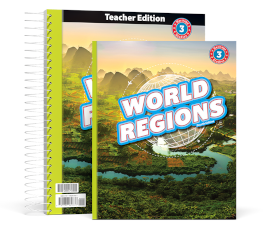
Heritage Studies 3: World Regions, fourth edition
Heritage Studies 3 is a study of world geography and cultures. The textbook’s ten chapters visit Africa, Europe, Asia, Oceania, North America, the Caribbean, Central America, and South America. In each chapter, students use maps to learn about major landforms, oceans, countries, and capitals, then focus on the same set of topics for each of the geographic areas. Those topics are the forms of government, geographical regions peculiar to the area, resources and economies, cultures, languages, and religions.
Call-out sections highlight other topics. For instance, the chapter on Europe includes a call-out titled "Let’s Explore!" that looks at German manufacturing, a page labeled “Early Cultures” that discusses the Minoans, a page labeled “Skills” that teaches students how to summarize information, a two-page, illustrated story from Grimm folktales titled “The Star-Money,” and two-pages that discuss Martin Luther under the heading, “People Who Make a Difference.” Other chapters include a folktale plus pages with the same call-out heading listed for Europe to cover topics related to the geographical area. Some chapters also have call-outs under the headings “Environment” and “How They Work.”
This textbook covers a lot of content, especially when compared to those for first and second grade. However, it is well organized and focused on teaching geography and cultures.
Our United States, Heritage Studies 4, fourth edition
 The first unit of the fourth edition of Our United States begins with a brief history of the U.S. from the settlement of America up into the 21st century. However, this information is included to provide some context for the study of the states. (The fifth-grade course teaches more comprehensive U.S. history.)
Units two through eleven break our country into regions, and then into individual states and territories. Each unit begins with an overview, and then typical coverage for each state includes sections about history, important people, important places, the environment (geography), the economy, and culture. Students learn some broader history of the U.S., but against the backdrop of the region or state. Because states are the primary focus, each state gets more attention than is typical for state studies at this level.
The textbook is written at a fairly easy reading level with short sentences, as in this example from page 28:
After the war with Spain, Theodore Roosevelt became president. He had many battleships built. Sixteen battleships were sent on a peacetime voyage around the world. Their frames were painted white with a golden bow. This was the first time steam-powered steel battleships sailed around the world. Roosevelt wanted the world to see America's sea power. The Great White Fleet made stops on six continents in fourteen months.
Historical information is presented simply and without much context. This is exemplified by the discussions of native Americans that generally portray them only in a positive manner. For example, on page 251, it says that several tribes lived in the Midwest forests and prairies. It continues, "French missionaries and traders arrived and lived in peace with these native peoples." Then it tells how native peoples were forced off their land. Nothing is said about the savagery of the tribes here or in several other sections about native Americans, where one would expect that to be mentioned.
The 537-page textbook features a large font and plenty of full-color illustrations, so it's not as daunting as it might appear. Pages in the Activities book are perforated and three-hole-punched so they can be removed and stored in a binder.
This year, students create a report on one state, using the preformatted pages toward the back of the Activities book. Instructions for this project are only in the Teacher's Edition. Students can use information from their textbook, but they should do additional research, with assistance as needed.
Note that this is an entirely new course rather than an edited version of the third edition. It has an optional Teacher Edition Companion, and online course videos, available in June of 2026. For those taking the video course, there is a packet of Student Handouts that include charts showing what is to happen each day, plus activity pages, some of which require cutting, folding, and pasting, such as two for creating the "Statue of Liberty Foldable."
History of America, Heritage Studies 5, fifth edition
 History of America covers the entirety of United States history from native Americans and exploration up to 2026. Coverage of native Americans is expanded from the previous edition and includes coverage of more recent discoveries.
Homeschoolers can buy the more practical teacher edition companion for this course instead of the teacher's edition.
Christian and politically conservative views are evident throughout the text. For example, on page 458 of the textbook, it says, "Government programs did not end poverty. Many of Johnson's programs actually made poverty worse." It goes on to contrast liberal and conservative views about government programs to pay for healthcare and spend more money on schools. This course introduces some hot-button issues and controversies, such as on page 561, where it points out the wrongful violations of personal freedom during the COVID19 pandemic and a strongly pro-life statement on page 582. It also clearly favors the Trump administrations over those of Presidents Obama and Biden.
"Biblical Worldview Shaping" topics are highlighted in the History of America: Teacher's Edition Companion. While worldview-oriented questions are presented in the Activities book, homeschool teachers will need to prompt discussions if they want students to think more deeply about these topics. For instance, page 151 in the Teacher's Edition Companion lists the Biblical Worldview Shaping objective: "Formulate a proper response to the death of the wicked and to injustice." However, nothing in the textbook or activities aids or directs students to do this. A parent would have to bring up the topic in response to reading in the textbook about the War on Terror.
Additional background information and activities are available on the Homeschool Hub. For instance, students are to complete a current events activity for Chapter 17, and the Current Events Template for this assignment is on the Homeschool Hub. (Page 2 of History of America: Teacher's Edition Companion suggests that students do this activity for every chapter.)
Toward the end of the course, students create and present a presentation on a president or first lady. A rubric is at the back of the Activities book.
The 500-page Activities book has two pages to be completed for most lessons, which, combined with the reading from the more than 600-page textbook, makes a significant amount of daily work. However, the textbook font is large, and the text is rich with images, so the reading should be manageable. The majority of the questions in the Activities book evaluate comprehension, but occasional questions ask students for more analytical responses.
Heritage Studies 6: Ancient Civilizations, third edition
Heritage Studies 6: Ancient Civilizations is the first in BJU Press’s series to cover world history. This text opens with a discussion about the study of history in general, and it makes the point that the Bible is a reliable source of historical information. Creation, the Fall, and Redemption are presented briefly as a backdrop for understanding the story of history.
Chapters two through thirteen study ancient civilizations: Mesopotamia, Egypt, Israel, India, China, Persia, Greece, Rome, the Byzantine Empire, Mesoamerica, Africa, and Japan. Chapter 14 moves up to the Middle Ages in Europe. Chapter 15 concludes by revisiting civilizations covered in earlier chapters but traces the work of God’s redemptive plan through them as well as the rise of conflicting worldviews. A “Christianity and Religions Chart” in the teacher’s resources might be especially helpful with this chapter.
Students will write several essays in this course within lessons and on tests. Students are guided through their first essay with a series of questions. The teacher’s resources include other helps for essay writing.
The teacher’s resources also have instructions for organizing a History Fair and for students to create fair projects. You might want to have a student create a project even if there is no History Fair.