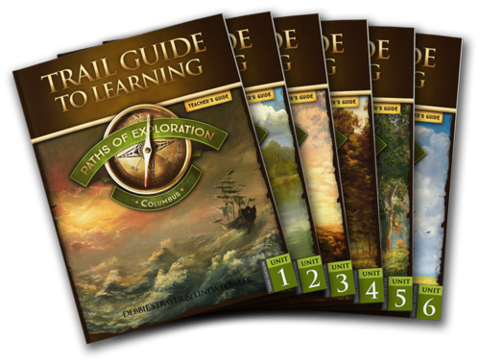
The Trail Guide to Learning series combines ideas from both Ruth Beechick's and Charlotte Mason's approaches to education which overlap and complement each other very well. The series uses a unit study approach built around geography as taught within the context of historical events. Science, art, and language arts are also covered, with language arts receiving a great deal of attention in a manner somewhat like that used in Learning Language Arts through Literature. Math is the only core subject not covered.
Trail Guide to Learning is projected to eventually be a program for students in grades one through twelve. At present, it has four courses each of which can be used as a one-year course across a number of grade levels from kindergarten through eighth grade. The first three courses cover American history (with world history added when relevant). The fourth course covers ancient world history, and the next two courses planned for the series will continue with the rest of world history.
The level of difficulty gradually increases as you move up through the courses. The first course, titled Paths of Exploration, targets grades three through five with younger and older extensions available for either kindergarten through second grade or for grades six and seven. Each course shifts up one year for the ideal target audience and brackets that audience with extensions for three grades below or two grades above the grade levels of the primary target audience. Extensions are available for the first three courses, but not yet for Journeys Through the Ancient World which targets grades six through eight. The extensions are terrific resources for keeping a broader span of children working in the same course.
In all courses, many assignments are marked with icons indicating appropriate grade levels. Icons make it easy for parents to assign the appropriate level of activity to each child or else show them how to select the activities themselves.
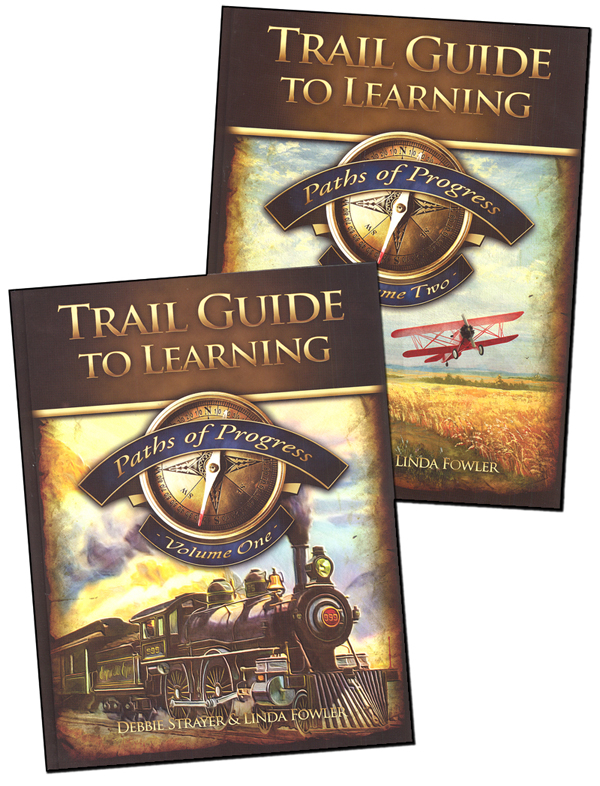
The first three courses are each divided into six units. The first editions of these three courses were originally published in two volumes per course, with three units per volume. The latest editions of Paths of Exploration and Paths of Settlement are now published in six softcover books, each covering one unit (six weeks' worth of material). While the printed version of Paths of Progress is still sold only as two hardcover books, it is currently being updated to the new format, and you can order it as individual PDFs for each of the six-week units. The newest course, Journeys Through the Ancient World, has been formatted into four nine-week units to fit better with a school year consisting of four quarters. The six-unit courses still break easily at the semester, so either arrangement should work just fine. You can purchase either complete courses or a unit at a time.
All course books, except the two-volume Paths of Progress which will soon be updated, have resource pages at the back. These are color pages, perforated for easy removal, with game cards, project instructions with color pictures, and other useful items.
How It Works
While these course books are called teacher's guides by the publisher, lessons are written directly to students. Nevertheless, parents need to introduce each unit and be involved from time to time. Whenever students are able to work independently, parents can hand them the course book to work through on their own. Students will need to stop and ask for parental help when they come to dictation, spelling words, narrations, and some other activities. Of course, with students who are not able to work independently, a parent can teach from the book, telling children what to do, reading to them, and leading discussions—adapting the language as needed.
Parents also need to purchase Student Notebook Pages in either printed or digital formats. As with the course books, these may be purchased for an entire course or by the unit. Student Notebook Pages are substantial—more than 2000 printable pages per course! These are mostly forms that students will use as they create their own notebooks, including pages for word studies, dictation, drawing, writing assignments, word searches, map work, scientific observation, spelling, etc. If you buy the digital files, they group the pages by grade level so you can print out worksheets that are appropriate for each level. Student worksheets often have checkboxes at the bottom for students to mark as they complete other assignments for which there are no student notebook pages. This helps children take on personal responsibility for completing all assignments.
Each course requires a number of other essential resources. These are mostly books, but generally, there will also be required audio resources and DVDs. For example, among required resources for the first unit of Paths of Settlement are Abigail Adams by Evelyn Witter, The Courage of Sarah Noble by Alice Dalgliesh, Profiles from History - Volume 2 by Ashley M. Wiggers, Eat Your Way Through the USA by Jamie Aramini, National Geographics Pocket Guide to the Weather of North America, United States Atlas published by Maps.com, Drive Thru History: Discovering America's Founders DVD, and USA Activity CD by Geography Matters. While you might be able to get many required books from the library, you will probably want to own those used for more than a few weeks. Geography Matters (the publisher of Trail Guide to Learning) sells the resources for each course if you want to buy everything in a convenient package.
Each unit focuses on a single theme that reflects a tight integration of geography and history. This approach covers fewer topics but in greater depth than we find in traditional textbooks. The unit themes in each of the first three courses are as follows:
- Paths of Exploration: Columbus, Jamestown, Pilgrims, Daniel Boone, Lewis and Clark, and Trails West
- Paths of Settlement: Growing Pains, Freedom Decided, Nation Building, House Divided, Unity Restored, and Sea to Shining Sea
- Paths of Progress: Great Leaps, Making Connections, Perseverance Pays Off, Cultivating Greatness, Success Takes Flight, and Reach for the Stars (from the Industrial Revolution into the beginning of the twentieth century)
The chronological thread of U.S. history is reflected in these themes. Paths of Settlement includes study of the individual states as well as a "home state project" which might satisfy any requirement for state study you have.
Shifting into world history, Journeys Through the Ancient World takes students back in time to Egypt, Israel, Greece, and Rome. The Bible is taught as both history and literature in this course, so students need a Bible to use along with it. Students will study astronomy, typing, and Hebrew along with other subject areas.
In the first three courses, Steps for Thinking at the beginning of each lesson present the big ideas that will be presented in the lessons. For example, in Unit 1, Lesson 3, Part 1 in Paths of Exploration, the Steps for Thinking are:
- When you learn about people, it helps you learn about things.
- Observation is a key skill needed for learning about things in our world. It is the basis for success in science.
- The goal of reading is to gain understanding. Hopefully, it is also a source of enjoyment.
Parents are to introduce these big ideas at the beginning of each week, then make connections to them as they work through the various lesson activities. (This is challenging to do if a student is working independently!) The Steps for Thinking are revisited at the end of the week (or completion of the lesson), at which point children should have a better understanding and ability to discuss what they mean.
The objectives normally found at the beginning of units or lessons in other curricula are instead located at the back of each book in Lesson at a Glance in the appendices. The Lesson at a Glance is actually a record-keeping chart where you can see and check off objectives as they are completed. Viewing all course objectives and being able to keep track of them in one place is very useful given that subject areas are often addressed with activities scattered throughout the day's lesson. For example, on one day a student might start with language arts activities, spend some time on history and geography, then complete additional language arts activities.
Lessons for each day are laid out in detail clearly enough for students to follow. Notes to the parent or teacher are in the margins of the books. These are frequently valuable tips or insights regarding teaching methods. The layout of the course books makes them very easy to use. You work through each lesson, selecting your choice of activities that are appropriate for each student. Some advance prep work is required to acquire books, print out student notebook pages if needed, and obtain any required materials. Answer keys are provided at the end of each week's lesson.
In the Trail Guide to Learning series, copywork and dictation are important techniques used for teaching language arts. Some student pages with copywork models are found on the website, but most copywork is done directly from assigned literature. Parents should adjust the amount of copywork as needed for each child.
Plenty of reading and writing activity is built into the program, but parents are instructed to adjust the amount and methods to suit each child. Both reading and writing are often taught in relation to the lesson theme or a related context. These reading and writing assignments are interspersed with discussion and other interactive activities to keep children engaged. Narration—children retelling to you in their own words what they have read or heard—is another method commonly used by Trail Guide to Learning that provides parents with feedback about how well children comprehend both their own reading or books read aloud to them.
Hands-on learning methods are built into lessons as drawing assignments, games, art projects, experiments, demonstrations, cooking, and other activities. Frequent discussions are a required element of all lessons. Students create a notebook of their work that does double duty, serving as a tool from which students make presentations demonstrating what they have learned and providing physical documentation of that learning. While the student notebook is the best way to document student accomplishments, you might prefer more traditional assessments. The optional Assessments CD for each course is useful in such situations.
While the first three courses have occasional assignments that require use of the internet, Journeys Through the Ancient World definitely requires internet access. Lesson notes often direct students to the "links page," a dedicated site with links for each unit of this course.
Covering Subject Areas
Language arts coverage is quite comprehensive including spelling, vocabulary, composition, grammar, public speaking/oral presentation, and reading comprehension. Some of these assignments focus on teaching particular skills, but as often as possible they tie to the lesson themes.
Students are assigned independent reading time each day and are encouraged to read something they enjoy. They keep track of what they read in a reading log in the student notebook. Biographies are prominent among the required resources, and there is a strong emphasis on character building through the study of exemplary characters.
As I mentioned at the beginning of this review, geography is a critical part of each theme, so each lesson features map work and other geographical activities that tie to the books and theme of that lesson. For example, those coming to Jamestown started from London. Students are to locate London on a map then trace a map of the United Kingdom and identify its countries. Next, they expand further to locate neighboring countries across bodies of water.
Science topics vary in each course, and art is often closely connected to science or social studies in the first three courses. In Paths of Exploration, science takes a naturalist approach as children learn to observe and record nature through drawing and writing. The North American Wildlife Guide and modified excerpts from the Handbook of Nature Study (written directly into the course books) are the primary science resources for this course. Art lessons are often (but not always) connected to science as children sketch what they observe. Lessons in basic drawing skills are incorporated into lessons. Additional art lessons are in Lewis and Clark Hands On, one of the required resources for the last three units of this first course.
The second course, Paths of Settlement, teaches earth science. National Geographic Pocket Guide to the Weather of North America and a Rock Study Kit are used with modified excerpts from the Handbook of Nature Study, again, written directly into the course books. Students do more-challenging reading, research, and discussion than for the first course. For art, students learn watercolor techniques which are then applied as they paint features of regions or states they are studying.
Science in Paths of Progress teaches the scientific process and broadens out to both life and physical sciences, teaching about friction, machines, tools, and anatomy. Art activities connect with other topics studied in Paths of Progress as students learn sculpting and model creation. For fine arts, children also learn about musicians and different types of music, orchestras, and musical instruments, and they learn to play a recorder.
In Journey through the Ancient World, students study astronomy, including conflicting views about the age of the earth, by using Astronomy for Every Kid by Janice Van Cleave, Backyard Guide to the Night Sky by Howard Schneider, What You Aren't Being Told About Astronomy DVDs, and the Astronomy Lab Book by Geography Matters. Students must apply critical thinking skills as they consider conflicting ideas, although the course is weighted toward a young-earth, creationist viewpoint.
In all courses, enrichment activities are included for advanced students. These activities might be reading recommended books or working on more elaborate projects.
Optional lapbooks for the first three courses are available in print, download, or CD versions. Lapbook activities can sometimes replace other activities. Lapbook icons are located next to activities when this is the case.
Religious Perspective
While the first three Trail Guide to Learning courses are not overtly Christian, they are premised on a Christian worldview, and a handful of the required reading books are definitely Christian, usually with a Protestant outlook. Those who want to incorporate an overtly Christian worldview should purchase the Light for the Trail Bible Study Supplement CD or digital download for each course. In these supplements, lessons tie directly to the themes of each course with suggestions for prayer and worship time, weekly memory verses, and ideas for making connections between faith and the topics being studied.
Journeys Through the Ancient World uses the Bible as an essential resource for the study of history along with other Christian resources such as Assumptions that Affect Our Lives by Christian Overman. So this course is definitely Christian, and there is no Bible supplement for it. Instead of Steps for Thinking at the beginning of lessons, it has Making Connections. These have students read either on their own or with a parent from one of the Christian resources or the Bible, then discuss and/or write their thoughts. The goal of Making Connections is developing an understanding of a Christian worldview and how that affects the way we should live.
Summary
The Trail Guide to Learning series is a promising solution for families seeking book-based unit study that is easy to use. It allows for more or less parental interaction depending upon your situation, although some interaction is essential. The series gradually moves students toward self-directed learning while making it easy for parents to keep track of student progress, a challenging balancing act to accomplish.