
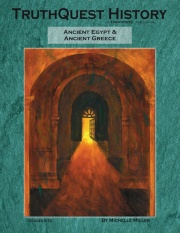
Many parents are insecure about using real books for history without some sort of guidance. TruthQuest History (TQH) is a great solution since it is a series of eleven volumes that serve as guides for a real-books approach to history. All TQH guides are available in either print or digital format. While the series as a whole covers grades one through twelve, each guide targets either a younger or older audience.
Guides recommended for grades one through five are:
- American History for Young Students I (Exploration-1800)
- American History for Young Students II (1800-1865)
- American History for Young Students III (1865-2000+)
Guides recommended for grades five through twelve are:
- Beginnings: Creation/Old Testament/Ancients/Egypt
- Ancient Greece
- Ancient Rome
- Middle Ages
- Renaissance, Reformation, and Age of Exploration
- Age of Revolution I (America/Europe, 1600-1800)
- Age of Revolution II (America/Europe, 1800-1865)
- Age of Revolution III (America/Europe, 1865-2000)
Each guide is divided into many chronologically-organized topical sections rather than the typical chapter arrangement. Michelle Miller introduces each of these topics with background information written in a lively, informal, conversational style.
After reading the background information for context, you and your students read from real books to learn more information about the topic. Miller recommends books, and sometimes chapters or pages within books, for each topic. She recommends a few spine books—books that are broad overviews of history such as A Child's History of the World, The Story of the World series, Dorothy Mills' series, and H.A. Guerber's history series. Then she lists many other books that cover specific topics. You can use spine books, topical books, or both. However, using at least some spine books will save you time. Video recommendations are generally added after the book lists.
Miller recommends some out-of-print books that you might still be able to find at a library, but she also includes many that are in print and available if you choose to purchase them. There are far more book recommendations than you will ever be able to use!
The chronologically organized topical sections I mentioned earlier are further divided into subsections that address important people or events within a time period. For example, the section on The Roaring 20s has an introduction with a list of general resources. This is followed by subsections with their own resource recommendations on topics such as the Scopes Trial; Eric Liddell and the 1924 Olympics; Prohibition, bootleggers, and gangsters; women's suffrage; baseball and Babe Ruth; Charles Lindbergh; Bessie Coleman; literary authors; scientists; music; and sports.
As you can see, you won't have time to cover every topic with real books. So it makes sense to either use a spine book for broad coverage along with a few narrower topic books or use as many topic books as you can reasonably get through and forgo efforts to cover very many topics.
Scattered throughout each book are a number of ThinkWrite exercises. These are writing assignments that require students to analyze the historical information they have learned from a Christian worldview perspective. For example, ThinkWrite 5 in American History for Young Students I says, “Please tell us your thoughts about America winning the Revolutionary War. How did America’s Big 2 Beliefs shape the war? Do you think you can see God’s hand in it?” (p. 91).
ThinkWrite questions are not intended to solicit only objective information. They also require children to make spiritual and practical connections. However, they still tend to support the philosophy of these guides. As long as you are aware of this and agree with Miller’s philosophy, this is not a problem. If you disagree with her Christian worldview, then you might want to come up with your own ThinkWrite-style of questions. Suggested responses to the ThinkWrites at the end of each book should help parents evaluate student work.
A unique aspect of TQH is a primary focus on the central questions of life: Who is God, and who is man in relation to God? How different people and civilizations answer these questions is reflected in the way they live and the choices they make. So these questions are the underlying focus of background information that Miller writes as she introduces each topic of study. This is probably most apparent in the Beginnings: Creation/Old Testament/Ancients/Egypt guide. You will be reading most of the Old Testament to your children through this study. The Bible might serve as your only spine book! This book probably has more of Miller's commentary than do the other guides, especially in the first section dealing with Genesis. Miller does a fine balancing act of presenting the key truths while leaving doctrinal interpretations up to parents. She does stress biblical truths that undermine evolutionary presuppositions, and she recommends many resources that support a creationist viewpoint. It will be up to parents how far to investigate that topic. Note that Egypt used to be covered in TQH's Egypt and Greece, but the study of Egypt was shifted and expanded into the Beginnings guide since it correlates historically with the story of the Bible.
TQH very much reflects a Francis Schaeffer approach to history based on his book How Should We Then Live? (In his book, which is published by Crossway, Schaeffer shows how historical events, scientific discoveries, artistic endeavors, literary pursuits, etc., were all shaped by religious beliefs and philosophies. Schaeffer's views are shaped by his Reformed Protestant beliefs.) In addition, Miller supports a limited-government perspective. Although she writes from her own Protestant viewpoint, from time to time she discusses conflicting Protestant and Catholic viewpoints on history, acknowledging right and wrong on both sides. I was pleasantly surprised to see this respectful balance, especially in the Renaissance, Reformation volume.
As you might have gathered by now, there is a very definite philosophy to these books. However, if you disagree with some of Miller's philosophy, you can still use these guides by skimming through the introductory material, sharing whichever parts of it you wish with your children, then moving on to the recommended reading and occasional video viewing. Some of the recommended books, particularly some of the spine books, reflect the philosophy described above. The Light and the Glory for Young Readers (Revell Publishing) would be one such example. On the other hand, some of H.A. Guerber's history books and Famous Men of Rome (from either Memoria Press or Greenleaf Press) are among others that are more neutral in their presentation. Since recommended spine books reflect a number of different philosophies, your choices of spine books will be particularly important in determining the tone of your study.
Supplements
TruthQuest History has collaborated with A Journey through Learning (AJTL) to create customized resources that help reinforce learning while providing hands-on and creative activities. Three downloadable PDF packages are available for each TQH guide. The first one, AJTL Binder Builder for TQH helps students create a fancy lapbook with lots of mini-booklets. The second, AJTL Notebook for TQH, provides notebooking pages for students to record information on most topics about which they are reading. AJTL Map/Timeline/Report Package for TQH includes maps, a timeline, historical figures to color, timeline markers, mini-timeline cards, and various report forms. All of these packages are optional, but they do enhance the courses.
Summary
You will have to watch the level of difficulty in the TruthQuest History guides. The TruthQuest History website has an extensive discussion about how you might select the appropriate guide(s) to use at www.truthquesthistory.com/howtochoose.php.
My impression is that all except the American History guides will work across the entire span of grades one through twelve as long as parents are judicious about how much information they give to each child—don't overwhelm the young ones, and do give the older ones plenty to work with. Ultimately, parents need to decide which assignments as well as which books to use with each child.