
All About Reading (AAR) is an intensive phonics program for pre-kindergarten through about fourth grade that uses the Orton-Gillingham methodology. With this method, 97% of English words can be learned according to phonetic rules, leaving only 3% to be learned as sight words.
AAR consists of two main parts: the Pre-reading program (teaching essential pre-reading skills) and the Reading program (consisting of Levels 1 through 4). I will briefly discuss a few features that apply to the entire program, then I will divide my review into two parts, covering the Pre-reading program first, then the rest of the program.
AAR is a highly interactive multi-sensory program that needs to be taught by the parent or teacher. However, the open-and-go lesson plans are scripted and illustrated, making it simple for the inexperienced parent or teacher to present the lessons with little or no prep time. Even though it is scripted, AAR is easy to adapt to each child’s needs by selecting among the suggested hands-on activities, choosing their favorite books for read-aloud time, and adjusting the pace and amount of interaction.
The phonetic readers are beautifully illustrated hardcover books that could stand on their own. They feature finely detailed, full-color drawings that are a delight in themselves.
Pre-reading Program
The All About Reading Pre-reading Program teaches essential pre-reading skills. The primary focus is on what the program's creator, Marie Rippel, calls the Big Five Skills™ that are foundational to a child’s future reading and spelling abilities: print awareness, phonological awareness, letter knowledge, listening comprehension, and motivation to read.
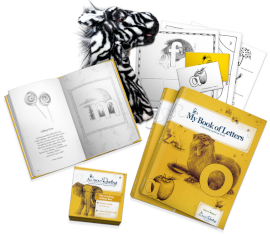
The AAR Pre-reading Program components are a teacher’s manual, a student packet, two read-aloud books, the Letter Sounds A to Z app, a Ziggy the Zebra hand puppet used to help teach many of the lessons, a card filing box, and reading divider cards.
Lesson plans include pictures and illustrations so you can quickly see which components of the program you’ll need for each lesson. It should take no more than fifteen minutes to read the introduction and start teaching.
The student packet includes the My Book of Letters student activity book, a progress chart, picture cards, letter-sound cards, both uppercase and lowercase alphabet charts, and a certificate of completion.
My Book of Letters contains one or two activity sheets for each lesson in its 192 pages. Some activity pages function more as teaching tools while others focus on arts and crafts, but all activity sheets contribute toward teaching the Big Five Skills. The activities can be simplified for children who don’t need as much cut-and-paste craftwork. You will need some additional resources for the activity pages such as scissors, glue, crayons, scraps of fabric and yarn, paint, toothpicks, cotton swabs, colored pencils, a hole punch, star stickers, pipe cleaners, glitter, and twigs.
The cards in the student packet are printed and perforated on card stock, ready for you to separate and store in the special card filing box that comes with the complete set. The alphabet charts in the student packet are used as teaching tools.
The read-aloud books are titled The Zigzag Zebra and Lizard Lou. The Zigzag Zebra introduces letters and their sounds in the context of rhymed text that often is a bit silly—just what children love. Alligators, kangaroos, frogs, snails, yaks, and other “critters” are the subject matter. Lizard Lou continues in the same vein but with lengthier poems, some from famous authors. These read-aloud books are used to develop listening comprehension and recognition of sounds in relation to illustrations. Poems contain sentence structure and vocabulary likely a little beyond what is already familiar to most preschoolers, so you might have discussions about some of the words and sentences. The nature topics themselves are also likely to engender discussion.
The Letter Sounds A to Z app (for computers and mobile devices) displays the letters of the alphabet. Children click on a letter to hear the sound. Only short vowels are included. Parents already familiar with the phonetic sounds might not need this.
All of the components and activities in the Pre-reading program work together nicely to contribute to the development of other readiness skills as children work with following directions, cutting, and coloring as well as listening, comprehending, identifying syllables auditorily, making inferences, developing vocabulary, and otherwise acquiring the Big Five Skills.
Levels 1 through 4
Beginning in AAR Level 1 and continuing through Level 4, the five key components of reading shift to phonological awareness, phonics/decoding, fluency, vocabulary, and comprehension.
Before starting Level 1, students should already know the alphabet and be able to identify both uppercase and lowercase letters. They might have completed the All About Reading Pre-reading program, but that is not required if you have introduced the alphabet and other pre-reading skills in some other fashion.
You will need the set of Letter Tiles (the same set that is used with All About Spelling) and the Reading Review Box which are used in Levels 1 through 4 of the reading program. The set of Letter Tiles includes one-inch square laminated phonogram tiles, magnets to affix to the back of each one, and tokens used in segmenting words. The Reading Review Box, which includes dividers and foam spacers, is used to organize the phonogram and word cards.
In addition to the essential items for AAR, you might also need a 2’ x 3’ magnetic whiteboard for both storing and working with the letter tiles, unless you purchase the Letter Tiles app, which takes the place of the physical letter tiles and whiteboard. Once you have set up your letter tiles and separated the phonogram and word cards, the program is easy to use. The scripted lesson plans guide you step by step. If you are not familiar with the sounds of the phonograms being taught in a lesson, you can use the Phonogram Sounds app to click on any phonogram to hear the pronunciation. (The app for computers and mobile devices can be downloaded from the website.)
The AAR program is incremental. The first lesson of Level 1 uses phonogram cards and letter tiles to teach the four sounds: /m/, /s/, /p/, and /ă/. Tiles are also used to introduce blending for three-letter words and to demonstrate how switching the first letter (e.g., using the words Sam and Pam) changes only the initial sound. Students also learn to identify vowels and consonants, which are color-coded on the tiles. Activity sheets in the student workbook add additional practice and, sometimes, additional instruction.
Lessons continue in this fashion, occasionally alerting teachers to strategies for overcoming common problems they might encounter. The introduction of letters follows a progression similar to that of other intensive phonics programs, gradually introducing vowels with consonants in a way that allows students to begin reading immediately.
All levels of AAR provide fluency practice through the word cards, practice sheets in the activity book, and readers.
The student activity books are a major component and add much variety to the lessons through short reading games and activities that motivate young learners. For example, in Lesson 3 of Level 1, students play “Feed the Monster” by reading words and then “feeding” them to the monster.
The hardcover readers in Levels 1 through 4 are just as top-notch as those for the Pre-reading Program, with lovely illustrations and relatively interesting content for vocabulary-controlled reading material.
AAR can be used independently or together with the All About Spelling program. Handwriting is not included as part of this reading program.
All About Reading Level 1
Lessons in Level 1 cover both short and long vowels, as well as some consonant digraphs, sight words, and even compound words.
AAR Level 1 materials include a teacher’s manual, a student packet, and three hardcover readers. The student packet contains the Blast Off to Reading! student activity book, phonogram cards, word cards, and a viewfinder bookmark. The perforated phonogram and word cards need to be separated and stored in the Reading Review Box.
All About Reading Level 2
AAR Level 2 continues to teach additional phonograms and rules such as the jobs of "silent e" and twelve new phonograms. Students use letter tiles to learn how to divide words into syllables as a decoding strategy.
The Level 2 materials include a teacher’s manual, a student packet (including the Leap into Reading activity book), and two hardcover readers. Students use more of the Letter Tiles as new phonograms are taught. Practice sheets are separated into “Easier Vocabulary” and “Harder Vocabulary” sections; you can work with both sections or just one, depending on your student’s needs. They include phrases and sentences to provide practice that is closer to reality than simply reading word lists.
All About Reading Level 3
All About Reading Level 3 broadens students’ horizons by teaching 17 new phonograms and exploring syllable types, suffixes, prefixes, and syllable division rules. Increasing emphasis is placed on reading comprehension and fluency through pre- and post-reading discussion activities. The Level 3 materials include a teacher’s manual, a student packet (including the Swing into Reading activity book), and two hardcover readers. Figurative language (personification, similes, onomatopoeia) is introduced, and practice is provided to help students develop meaningful expression when reading aloud.
All About Reading Level 4
The fourth and final level in the AAR program builds on previously introduced concepts by teaching a wide range of suffixes, 15 new phonograms, words with silent letters, and words with unaccented syllables. It also introduces students to more advanced concepts such as word morphology, dialects, and words with influence from other languages (Greek, Spanish, French, and Italian). The Level 4 materials include a teacher’s manual, a student packet (including the Soar with Reading activity book), and two hardcover readers. A variety of story elements and additional examples of figurative language are also covered.
Summary
All About Reading is a very reasonably priced option for an interactive, multi-sensory reading program that is scripted and easy to use. All components except the student workbooks and star stickers are reusable, so the value is even greater when you use it with more than one student.