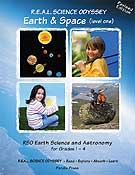
Six volumes are available thus far in REAL Science Odyssey series designed for those pursuing a classical form of education. Each volume should require one school year to complete.
Volumes are written at two different levels, with grade levels covered varying even within each level. Level one courses can be used with children as young as kindergarten level, and they go as high as sixth grade. The second-level courses can be used for grades six through ten. To a certain extent, you can use the volumes for any one level in the order you please. See the recommended grade levels next to each title.
Volume titles and levels are as follows:
Level one:
- Life Science (grades K/1-4)
- Earth and Environment (grades 1-4)
- Astronomy (grades 1-4)
- Chemistry (grades 2-5)
- Physics (grades 3-6)
Level two:
- Biology (grades 6-10)
- Astronomy (grades 6-10)
Volumes purposely narrow the field of topics for each year to provide more in-depth and hands-on study of topics rather than shallowly covering a broad range of topics as is often done in standard textbooks. Lessons follow a sequence so that they build one upon another, both in progression of topics and in the use of vocabulary. It should take a full school year to complete each volume. However, Earth and Environment and Astronomy were both developed based on the previous Earth and Space course. Additional content has been added to both books, but they are a little lighter in content.
The author accurately describes this as both a classical curriculum and a "hands-on, minds-on" program. Each lesson is built around hands-on activities, but students are also challenged to think about what they are doing and learning rather than simply enjoying the activities and making observations.
I reviewed only some of the Level One courses. Since the books I reviewed are for children in the elementary grades, they function primarily for the grammar stage of classical education with a concentration on vocabulary and basic facts. However, I was pleased to note that even these Level One books often take children beyond the grammar stage into more thought-provoking analysis. This is a great introduction to the use of the scientific method. Also, while an extensive amount of vocabulary is taught, children learn the vocabulary through usage and exposure rather than memorization.
Students create their own notebooks with reproducible activity and information pages from the book. Families are given permission to reproduce pages for children in their immediate family. When you order, you need to choose either the ebook or the bound version with perforated pages. The perforated pages are easily removable for copying.
Students are also encouraged to keep a science journal. Suggestions for journaling are at the front of each volume. The amount of writing required for the activities is very reasonable, but journaling might significantly increase the amount of writing.
Each lesson begins with a list of materials needed. A comprehensive list at the front of the book will help you gather or purchase all the items in advance so you don't end up scrambling to find what you need as you begin each lesson. Many are common household items like tongs, funnel, ice pick, stapler, cheese grater, dry erase marker, kitchen knife, tweezers, cookie sheet, and glue. You will likely have to order others like an inflatable globe, an outdoor thermometer, a rock and mineral kit, a gram scale, a glass eyedropper, binoculars, a fishnet, and a metal Slinky. (Sources are suggested for the unusual items.)
Next in each lesson after the materials list is a paragraph in bold typeface that parents might read aloud to their children to introduce the topic and, perhaps, some of the vocabulary. Then it is time to move directly into the "lab" activity. Activity sheets are provided for students to record observations or data, make drawings, or fill in the blanks.
Younger children (and maybe even some fourth graders) are likely to find some of the math over their heads. Different types of measurements are used throughout the lessons, and children will use both the metric and English systems. They also do so simple graphing. I noticed that a lesson in the Life volume uses multiplication, a concept that some children might not yet have learned. But the multiplication instance is atypical, and the math should not be a problem throughout the curriculum. Still, parents need to note lesson items that might be too challenging for their children and either provide the necessary help or skip parts of the lesson.
Notebook pages are written directly to children. These present the key ideas and vocabulary for each lesson. Again, some children will not be reading at the level required and will require parental assistance.
At the front of each volume are extensive lists of books and websites for each unit. None of these books (other than field guides) are required for the lessons. No specific pages from any books are listed for lessons. Theoretically, you could do only the activities and pages in the lessons, but I suspect you will enjoy the program more if you intersperse reading from some of these recommended books, or by researching and reading from websites. You should also try to dedicate a day for science journaling every week or so. You might arrange your weekly schedule so that a large block of time on one day is set aside for the lesson and lab activity, another day is used for journaling, and on other days you read for a short period of time from one of the recommended books or from websites.
Having said that, I would also recommend using fewer of these activities and books with a younger child than with an older child.
This program requires parent preparation, presentation, and supervision most of the time. You can purchase volumes in print or digital editions. Extra sets of student pages are available for those teaching more than one child.
The first-level courses have no religious content. They avoid the discussion of evolution, but they do present an old age for the earth.
Level Two Courses
As I mentioned above, I have not yet reviewed the second-level courses, but here is some basic information. Both courses include lab work, and most lab supplies are household items. They can qualify as lab courses for college requirements, although Astronomy 2 is only one semester.
Biology 2 has a textbook, a teacher guide, and a student workbook. This is a year-long course that does not require a teacher who knows the topic. It includes teaching based on the theory of evolution.
Astronomy 2 is a one-semester course that has two required components: the textbook and the teacher guide. An optional student notebook is available.
Summary
REAL Science Odyssey should be a good choice for those who want a hands-on approach to science that has strong content that is presented from a secular point of view.