My Father’s World (MFW) offers complete grade-level programs for preschool through twelfth grade. MFW employs methodologies from unit study, Charlotte Mason, and classical approaches with a strong biblical base (Protestant) and missionary emphasis throughout all levels. Each program centers around a single guide and uses a mixture of real books and hands-on activities along with a few textbooks. A Bible (not included) is required for every level.
MFW courses are clearly structured with easy-to-understand instructions. Lesson preparation time will be required primarily for gathering necessary materials, so planning ahead is essential.
Samples of each level are available on the publisher’s website. This review covers courses for kindergarten through eighth grade. Click here for My Father's World: preschool program for two- and three-year-olds, here for their pre-k program for ages three and four, or here for "My Father's World: high school program.
God's Creation from A to Z: Complete Kindergarten Curriculum (second edition)
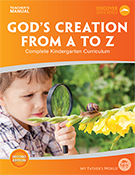 MFW's kindergarten curriculum focuses on beginning reading, math, science, social studies, and Bible appropriate for children who are just ready to begin learning letters and sounds. (Expansion ideas are provided for kindergartners who are already reading.) Many activities in the book—especially those not targeting beginning number and letter skills—easily adapt for use with younger or older children.
God’s Creation from A to Z includes a Christmas unit for December with Bible stories and hands-on activities. Children also enjoy a Fruit of the Spirit unit at the end of the year that focuses on character traits (love, joy, peace, etc.), cooking, science, and more. Both of these units have colorful Student Sheets.
Charlotte Mason's influence is strong with the incorporation of real books and hands-on learning throughout the program. Susan Schaeffer Macaulay’s book about Mason’s methodology, For the Children’s Sake, is referred to several times in the kindergarten guide and is included in the package.
The introductory unit, which should take about ten days to complete, covers creation and introduces the names of the letters of the alphabet. The next 26 units (centered around themes such as the sun, leaves, or water) integrate lessons on sounds of the letters and beginning blending (short-vowel words only) with the unit themes. All learning is multisensory, combining worksheets, oral work, listening, movable alphabet, flashcards, and lots of hands-on activities.
For example, Week 13 teaches about insects, emphasizing the biblical concept of working hard (diligence). Ants, bees, and ladybugs are used as examples. Students learn the “A-a-Apple” song, and they learn the short i sound for insect. You are to read aloud about insects from God's Amazing World and watch the companion video "Insects" (developed by the Wild Brothers for this course). Children also go outside and make guided observations about ants, watching insects at work.
Many learning activities use A-Z letters (these come in the package), tactile activities (e.g., finger jello cut into letter shapes, pancakes formed as letters), and verbal responses. Simple science experiments, craft projects, and literature are built into the lessons.
Each week includes a featured read-aloud book with related activities plus an “outdoor time” activity. Math is often integrated into the lessons with activities such as sorting leaves by color and size or cutting an apple in half. Skills covered include shapes, comparing and sequencing, measuring, the calendar, money, graphs, fractions, time, counting, writing numbers, and an introduction to addition and subtraction.
Lessons should take 60 to 90 minutes a day, and there are sufficient lessons here for a full school year. Lessons for each unit are presented in a grid for a quick overview of what you will be doing. Additional notes follow for each day, but there is minimal teacher manual information that you need to read before jumping into the lessons.
A variety of pages are provided in the large packet of Kindergarten Student Sheets—cut-and-paste activities, teaching charts, game cards, short-vowel song cards, monthly calendars, math activities, and patterns for badges.
To make things easier, MFW offers a package that includes the Teacher’s Manual, Student Sheets, a beautiful set of alphabet flashcards, A-Z lowercase letters, an inflatable globe, Say Hello to Classical Music, KEVA 30 Maple Planks and Cards, For the Children’s Sake, and several read-aloud books. God's Amazing World provides science information for each of the 26 units. Extensive, annotated lists of optional recommended books, organized by weekly themes, should make it easy to find additional books at your local library.
Some inexpensive art supplies such as clay, watercolor paints, and paintbrushes will be required; a few more such as tempera paints and colored pencils are optional. You will also need an extra set of Kindergarten Student Sheets for each additional student.
Learning God's Story (1st Grade)
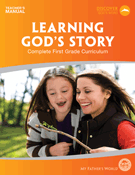 This first-grade program very quickly reviews letters and sounds, then introduces short vowel words. All basic phonics concepts are presented this year. Spelling and writing both receive much more emphasis this year than in kindergarten. Science in the first-grade program relies heavily upon three Usborne books —Things Outdoors, Science With Water, and Science With Plants. Dimensions Math 1A and 1B is combined with hands-on math activities plus math resources from the First Grade package to provide a developmentally appropriate foundation in math principles.
The First Grade package includes the teacher’s manual, student workbook, student sheets (which include timeline figures), Bible Notebook, Bible Reader, three Usborne science books, a devotions book, Dimensions Math 1A and 1B, math flashcards, math manipulatives, Drawing with Children, Honey for a Child’s Heart, Eric Carle's Animals Animals, Tales from Cherry Lane, Enjoying Art Together, and Peter and the Wolf.
This course builds a very strong familiarity with the Bible since it uses chronological Bible readings as well as the Bible Reader and the Bible Notebook. Children learn memory verses and complete written work in relation to their Bible lessons.
Minimal lesson preparation is required. Daily lesson plans provide detailed instruction and are easy to follow. Some cut-and-paste activities are used from time to time, and there are numerous optional projects such as a celebration of the Jewish feast of Purim. Children are asked to draw in many of the lessons, and Hazell suggests using the book Drawing with Children for developing drawing skills.
Adventures in U.S. History (2nd Grade)
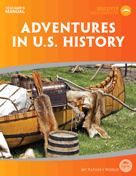 NOTE: This program is designed for a second grader who is the eldest child. Families with older siblings should instead purchase one of the 2nd-8th programs so that all students are working on the same topics.
Adventures in U.S. History provides a complete curriculum for Bible, history, geography, science, art, and music, with United States history being the primary theme for the year. Students do increasing amounts of reading and writing at this level. There is some language arts instruction, but it is not comprehensive. You need to add your own math and language arts resources. MFW recommends and sells Dimensions Math, MFW's Language Lessons for Today, and Spelling by Sound and Structure (Rod and Staff). The study of a foreign language is recommended but not required.
Moderately detailed lesson plans are provided for each day. You need minimal prep work before teaching the program: gathering or buying general school supplies and art supplies for I Can Do All Things, gathering library books, planning nature walks, and reading the first sections of the teacher’s manual.
The package includes the teacher’s manual, a two-sided U.S./world map, student sheets (which also include state sheets/cards/stickers), Patriotic Songs of the U.S.A., and books such as NIrV Discoverer’s Bible for Young Readers, The Story of the U.S., American Pioneers and Patriots, North American Indians, The Fourth of July Story, First Encyclopedia of Science, Science with Air, and Birds, Nests, and Eggs. Also included are an art program, science and fine art resources, and seven additional read-aloud books.
At the back of the teacher's manual are pages of still more book and video recommendations (annotated with short descriptions) that are arranged very helpfully week by week so you can easily browse through possibilities for alternatives or additions to the curriculum.
World Changers (3rd Grade)
 World Changers should be used with third graders who are the eldest child but can also be used by a second grader. It provides complete coverage for Bible, world history, science, art, and music. While some language arts skills are taught, you need separate resources for language arts and math.
World Changers uses a unit-study approach based on stories of people from around the world and throughout history. A few of those people are Joseph in Egypt, Monica and Augustine in ancient Rome, John Wycliffe, Johann Gutenberg, Rembrandt, Susanna Wesley, Florence Nightingale, Billy Graham, and John Glenn.
Students create a History Notebook this year to integrate history, composition, and handwriting.
Resources in the World Changers package include the teacher's manual, student sheets, Little Pilgrim's Progress, Inventor's Workshop, Kitchen Chemistry, I Can Draw!, Drawing Textbook, The Mills Family of Entrepreneurs, God is in Nature!, Little Miriam of Galilee, Official Guide to the Marvelous Museum of Salt and Light, Five Tales, The Story of Pollyanna, the WCH Science Set, the Plus-Plus Basic set, a world wall map, a soprano recorder, and the book Recorder Classroom Method.
2nd - 8th Grade Multi-Age Curriculum
While the preceding programs all have narrower age or grade level designations, the next sequence in MFW consists of five courses, any of which might be used for students in grades two through eight. Ideally, you would use them in sequence, no matter at what grade level you begin. You might complete all five courses in grades two through six then repeat the first two at a more advanced level for seventh and eighth grades.
The first year of the five-year cycle is dedicated to a concentrated study of geography and cultures in Exploring Countries and Cultures. The next four courses follow a chronological order:
- Creation to the Greeks
- Rome to the Reformation
- Exploration to 1850 (U.S./World History)
- 1850 to Modern Times (U.S./World History)
As with the other MFW courses, these five courses use real books and lots of hands-on activities to cover Bible, social studies (history and geography), science, art, and music.
You might consider these as unit studies, although study in all subjects is not as tightly linked to unit themes as in other unit studies. For example, music study might be about a composer from the period studied in history, or students might study Greek and Latin word roots while working through the courses that include study of the Greek and Roman empires. However, textbooks and other resources are also incorporated to cover specific topics that might not fit with the main themes. For example, children learn the music of Bach, Vivaldi, and Handel during their study of Creation to the Greeks (ancient history).
Language arts are covered with your choice of other resources, although children will be working on some language arts activities within the curriculum itself. MFW suggests and sells resources such as Spelling Power, Applications of Grammar, Writing Skills for Today, and Language Lessons for Today for language arts.
Math is not included in these courses, although My Father's World recommends and sells Dimensions Math for students in grades two through six and Saxon math and other courses for older students. Seventh and eighth graders also need to add an appropriate science course.
Teacher’s manuals feature daily lesson plans with additional notes and explanations alongside each week’s chart. The charts show specific pages and activities within the core resources. All resources listed in the schedule charts are included in MFW's packages.
Student sheets included with each year’s package are pages for creating a timeline, plus many others for activities such as map work, crafts, and written work. As with Adventures in My Father’s World, students will need to maintain two three-ring binders for their work for each course.
Exploring Countries and Cultures
As the title suggests, this course teaches about other countries and cultures. It is selective rather than comprehensive in coverage, an approach entirely suitable for a young audience. While all continents are visited, only a few representative countries are studied at length. Protestant missionary biographies, stories from Hero Tales (heroes of Protestantism), and information from Window on the World (missionary efforts and status worldwide) are assigned for reading within the lesson plans, often coordinating with the country being studied that week. For example, the biography of Gladys Aylward, a missionary to China, begins during the study of China and continues through the study of Japan.
Of course, other resources are also used along with Exploring Countries and Cultures. The package includes the teacher’s manual, Parent/Teacher Supplement, and student sheets. There are also other items such as an imitation passport, God Speaks Numanggang, Hero Tales, Window on the World, Children's Atlas of God's World, Geography from A to Z, Properties of Ecosystems, Living World Encyclopedia (Usborne), A World of Art, and several read-aloud books. The teacher’s manual also has a list of optional, recommended books to enrich the topics addressed within each week’s lesson.
Seventh and eighth graders have additional coursework scheduled in the lesson plans. You need to purchase the 7th-8th Grade Supplement if you are teaching older students.
Creation to the Greeks
MFW strongly recommends that children complete Exploring Countries and Cultures before beginning Creation to the Greeks so they have foundational knowledge of countries and geographic terms that will be used.
The outline for this study follows the Old Testament, beginning with creation and continuing through the rebuilding of Jerusalem after the exile (book of Nehemiah). Following the biblical timeline, students also learn about ancient Mesopotamia; Egypt; the Babylonian kingdom; early North American cultures; other ancient cultures of the Middle East, such as those of the Canaanites, Hittites, Philistines, Phoenicians, Assyrians. They study ancient Greece (including some Greek mythology), India (including a brief study of Hinduism and Buddhism), early Russia, and the Persian empire, culminating with the exploits of Alexander the Great. Celebrating Biblical Feasts incorporates the study and celebration of the Old Testament biblical feasts.
Some of the core books, such as Streams of Civilization Vol. 1, are significantly more challenging than those used for Exploring Countries. The lesson plans help you navigate through the resources, specifying some reading for all ages and other reading only for older students and the parent/teacher.
Examples of resources in the package are Usborne Encyclopedia: World History from Ancient to Modern Times, The Trojan Horse: How the Greeks Won the War, Dinosaurs of Eden, Pyramids, Science in the Beginning, and English from the Roots Up, plus read-aloud books such as Aesop's Fables for Children and The Tanglewoods' Secret.
The teacher’s manual also includes a list of optional recommended books to enrich topics addressed within each week’s lesson.
Rome to the Reformation
The layout and methodology for Rome to the Reformation are essentially the same as for Creation to the Greeks. The assumption is that you have just completed Creation to the Greeks and already have some of the resources used with that course.
Examples of resources in the course package are The Roman Empire, Augustus Caesar’s World, The Story of the World Vol. 2, Trial and Triumph: Stories from Church History, The Human Body for Every Kid, The Wonderful Way Babies Are Made, and Exploring Creation with Astronomy. The teacher’s manual again includes many pages of optional book and video recommendations for each week of study.
The human body and astronomy are the primary science themes for this year. There is a lot of reading material included, but you will not be reading every page in every book, so it is not as overwhelming as it might seem.
Note that history coverage is not restricted to western civilization but includes Japan, India, Australia, and other far-flung places.
Exploration to 1850 (U.S./World History)
Exploration to 1850 is appropriate for students in grades four through eight. Seventh and eighth graders will use some more challenging resources than younger students. Of course, resource recommendations for math and language arts vary by the student’s grade level. You will need to add the 2nd-3rd Grade Supplement if you are teaching younger students.
Exploration to 1850 combines both world history and early U.S. history. It uses core resources such as The Story of the World: Volume 3 and George Washington’s World that take a story-telling approach to history along with texts, such as Exploring American History and Building a City on a Hill. The last four to six weeks of the year are used for students to write a report on their own state while learning simultaneously how to write a research paper. Science this year is a study of plants and animals. Seventh and eighth graders use different, age-appropriate science texts. Resource recommendations for math and language arts vary by the student’s grade level.
1850 to Modern Times (U.S./World History)
1850 to Modern Times continues to intermix U.S. and world history, covering events in chronological sequence, but with an underlying theme of heroic Christian virtue in response to God’s call. You will need the 2nd-3rd Grade Supplement if you are teaching a student younger than fourth grade.
The course continues with a few books that you might have already begun in Exploration to 1850. Science introduces students to physics and chemistry.
Among the resources included in the course package are Tales of Persia; States & Capitals Songs; The Story of the World, Vol. 4; American History: A Visual Encyclopedia (© 2019), Exploring Creation with Chemistry and Physics, and several read-aloud books.
For a review of "My Father's World: high school level, click here.