

Building on the Rock is an ambitious curriculum that presents both a biblical Christian worldview and Bible study in six courses for kindergarten through fifth grade. The folks at Summit Ministries have done an outstanding job with their programs for junior and senior high, and this program builds a foundation that begins in the elementary grades. As it says in the introduction to each course, "[T]his curriculum will help young students formulate a biblical perspective of the world and then live accordingly" (Building on the Rock Teacher Manual, p.8).
The first two-thirds of each year-long course teaches about worldview, while the last third is part of an ongoing introductory course about the Bible. Twenty key biblical truths are foundational for the worldview part of the courses. These are first presented in the worldview section of each course then incorporated into the Bible survey lessons. Godly character traits are also taught through all six courses.
The kindergarten course is a little different than the others since it presents all twenty biblical truths, all of the character traits, and a cursory survey of the key stories of the Bible from creation through the resurrection. For the next five years, the courses follow a spiral progression—each year's course concentrates on some of the 20 biblical truths and reviews others, teaches some of the character traits, and works through a section of the Bible. This design allows students to enter at any level and still pick up the key concepts.
The program was developed for classroom use and is best suited for group settings if you want to use most of the course content provided. Lesson preparation and presentation both require quite a bit of time if you use the object lessons and other teaching strategies. However, these might not always be necessary in homeschool settings. Lesson plans also assume the presence of a group for discussion and interaction, but your family can serve as your group. (To use the program with your family, you need to select only one level of the program to use each year, and generally, it will be best to start with the first level.)
For each level, you will need the teacher manual, and each student needs a workbook. At the back of each teacher manual are discs with supplemental files: blackline masters, transparencies, and songs (MP3). The teacher manuals are hefty books that might seem a bit overwhelming at first glance. But once you have familiarized yourself with the curriculum, they should be relatively easy to use. You will also need a Bible. Summit Ministries says that any common English translation of the Bible will work, and they sell The Action Study Bible ESV, an edition of the English Standard Version of the Bible with illustrations and graphics that appeal to a young audience.
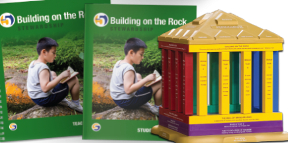
The entire curriculum references the biblical story of the wise man who built his house upon the rock. An optional, plastic "House of Truth" model is used to represent students building their spiritual homes piece by piece as they proceed through the courses. (The House of Truth is pictured in the image that accompanies this review.) You can buy the kit for this model, but Summit Ministries also provides a free do-it-yourself option that you can print out on cardstock and put together. In this case, you build the model all at once rather than adding pieces gradually, but it still works as a visual aid.
I'll begin with the worldview part of the course. It is important to note that this part is entirely Bible-based since the worldview under discussion is premised upon a sola scriptura Protestant foundation. The twenty key biblical truths are taught over the course of the entire program, and they are buttressed with many other scriptural references.
For example, the first truth taught in the kindergarten course is "God's Word is the rock." The model is used to show this concretely, with the base piece labeled "The Rock: God and his Word." Subsequent lessons each year continue to build the model with additional pieces labeled with biblical truths while also reviewing the pieces (and their biblical truths) already in place. While each course begins with a variation of this same theme—building on the rock and the trustworthiness of God and his Word as our foundation—lessons diverge as they address other biblical truths and topics.
The worldview lessons are grouped into units. Each unit (or sometimes groups of units when those units are brief) begins with overview and preparation information for the teacher. Here you will find the biblical truth (or truths) to be taught, key themes, character traits, a memory verse, an overview, a summary of key concepts, and a list of all supplemental resources from the blackline masters, student workbook, and transparencies.
Each lesson is to be presented over four days per week, so every lesson is presented in four parts. Briefer lists of required supplemental resources are included in a sidebar for each day's lesson. Also in those sidebars for each day are the songs to be used (which are referred to as Bible Truth Couplets), materials needed, and other preparation to be completed. You need to prepare in advance since you might need to collect or purchase items or plan for outings or activities.
Lessons are laid out in great detail and need to be presented from the teacher manuals. The teacher manuals explain what to discuss, visual aids to use, and questions to ask. They also include short stories to read to children.
Following is an example of how a lesson flows. The objective for day one of the first lesson in the first-grade program is for students to understand the importance of following good directions and plans for their lives. The lesson uses an analogy of house building, beginning with a discussion about house building and building supplies that will be needed. It also has the teacher provide an architectural floor plan for students to see how a builder knows what to do. Then the teacher introduces the story of Wise William, creating an object lesson with resources they've gathered to show William building his house on a solid foundation that withstands water. Questions are provided to guide the discussion. The lesson presentation concludes with a quick assessment activity that might be done orally in a homeschool setting. A colorful student workbook page has three spaces for children to draw different aspects of Willliam's story. Optional enrichment activities include an additional Bible-based discussion and a suggestion to invite an architect to the classroom. Lesson activities vary from day to day, so this is only a sampling of what it might look like on a single day.
The Bible survey part of the course takes the last third of the school year. As I mentioned, the kindergarten course covers from Creation to the Resurrection, drawing from the both Old and New Testaments in a cursory fashion, The first-grade course then starts again with the creation story and goes more in depth through the stories in the book of Genesis. The second-grade course focuses on Exodus, third grade draws from 1 and 2 Samuel and 1 and 2 Kings, fourth grade is about major and minor prophets, and fifth grade teaches from the four gospels. The Bible lessons continually tie back to the worldview lessons, integrating ideas with the stories in ways that young children can comprehend. Lessons are taught in a fashion similar to the worldview lessons with visual aids and activities. The student workbook activities then reinforce the lessons already presented by the teacher.
The classroom design of Building on the Rock makes the curriculum a bit cumbersome for homeschool families. But if you can put in the lesson preparation and presentation time, it should be very effective and interesting for your children. The detailed lesson plans really make it possible for parents to transmit crucial worldview ideas to their children.
Stepping back from all these details, I think it is important to understand that this curriculum is trying to build a philosophical foundation for a Christian worldview, something I've never seen done so clearly and purposely in any other Bible curriculum for young learners. It begins with how we learn or know about God. It talks about the importance of knowing what God has to say to us and the idea that there is Truth that God has revealed. It deals with the fundamental human questions of who we are in relation to God as well as our relationships with others and with God's creation. And it does all this on a level appropriate for young children. In addition, the wealth of information for teachers will help those with shaky worldviews shore up their own foundations.