

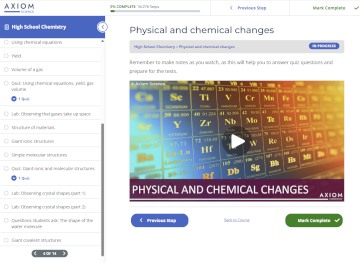
Axiom Chemistry is a self-paced, online chemistry course with labs for high school. It does not require a separate textbook, since all course content is presented online through video lectures. Students must take notes as they watch the lectures, and they can use those notes when they take quizzes and study for exams. While the course is predicated on a Christian worldview, no religious content is included.
The course has five modules:
- Introducing Chemistry
- Bonding and Structure
- Inorganic Chemistry
- Organic Chemistry
- Physical Chemistry
Axiom Science also has an IGCSE Chemistry course designed specifically for UK students. It adds a sixth module for review and preparation for the IGCSE exam. I reviewed the regular course, since that is what most students will use.
The teacher Nicole Jeffery, has a British accent and occasionally uses British terminology, such as “nought” for zero and the word gaseous pronounced with a long a. In the lesson on Units and Terminology, she explains some of the terms that vary from country to country, but the course should work for students around the world.
How Axiom Chemistry Works
Each module has several instructional videos, labs, and quizzes, plus additional videos titled “Questions Students Ask,” that address common confusions, questions, and real-life applications of chemistry. There are 191 videos in all, each running from about 5 to 15 minutes.
Instruction is presented via the videos with voice-over by Jeffery as she presents slides, animations, and simulations. Jeffery occasionally adds stories about the historical development of chemistry, which students should find interesting. As I mentioned previously, students need to take notes to prepare for quizzes and tests. Jeffery summarizes key points at the end of each video to ensure students have these in their notes and are prepared for quizzes and tests.
Students cannot proceed until they mark each lesson component complete. However, they can go back and review previous course material.
Frequent online quizzes—30 in all—check student comprehension, and students are allowed to use their notes for the quizzes. However, they are not allowed to retake the quizzes.
Plenty of review before the test at the end of each module includes demonstrations of problem-solving. The summary tests for modules 2, 3, and 4 include questions from all prior modules. A set of final tests at the end of the fifth module is preceded by a week of review of all five modules. Like the quizzes, tests are automatically graded, and students cannot retake them.
After completion of a quiz or test, students can view which answers were correct or incorrect and the explanations for each answer. Parents can quickly view quiz and test scores by clicking on the “In Progress” button.
Labs Can Be Done at Home
The 20 labs completed with this course require common household products and a few specialized products that can be easily purchased through Amazon or other retailers, such as a digital scale, a measuring “jug” calibrated in milliliters, a nine-volt battery, safety glasses, test tubes, a Centigrade thermometer, and electrical wires with alligator clips. A few item descriptions include both U.S. and British terms and brand names. For example, the required alum is described with its chemical name, potassium aluminum sulfate, and it is also described as fatakdi powder, the name under which it is commonly marketed in Britain.
The list of lab resources is available for download under the Resources tab at the top right of the dashboard when you first login as well as .
Before performing the first lab, Jeffery explains how to write a lab report. She includes her own procedures, observations, and explanations for each experiment, so there’s no guesswork about expected outcomes, and students can view samples of lab reports for all experiments under the Resources tab. Parents might want to use the Lab Report Grading Guidelines, also found there.
Jeffery walks students through every step of each experiment on videos and suggests optional further investigations.
Labs are followed by explanatory lessons that further develop what students have learned from the experiments, so information taught in the lessons is reinforced and developed through labs.
It is possible for a student to complete the course without actually performing the labs. Watching the videos will teach the concepts learned from the labs. However, the process of actually doing the labs and writing reports is valuable in itself, so I recommend that students actually do them.
Summary
Axiom Chemistry provides solid coverage of high school chemistry in a format that’s practical for homeschoolers working on their own. While the content is appropriately challenging, the lessons are easy to follow, and the summaries and reviews prepare students well to pass the quizzes and exams.